Malacostraca |
Decapoda |
Carpiliidae
Environnement : milieu / zone climatique / profondeur / gamme de distribution
Écologie
Récifal; profondeur 0 - 95 m (Réf. 96667). Tropical; 37°N - 32°S, 30°E - 108°W
Indo-Pacific: from Japan, Hawaii and the Red Sea south to South Africa and Mozambique, west to Eastern Africa and east to French Polynesia and Easter Island.
Longueur à la première maturité / Taille / Poids / Âge
Maturité: Lm ? range ? - ? cm Max length : 15.0 cm CW mâle / non sexé; (Réf. 343)
Description synthétique
Morphologie
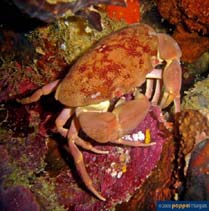
Carapace ovate; dorsal surface very smooth and convex. Color: uniform red to reddish brown, with irregular dark brown patches on the dorsal surface of carapace (Ref. 343). Pincers are stout and unequal in size (Ref. 128968).
Found under stones or cracks in coral reefs (Ref. 128968). Collected extensively for food in some areas (Ref. 343). May contain toxins that are undectectable in tests (Ref. 107779), and thus, may not be safe to eat (Ref. 128968). Found in the littoral to sublittoral zones (Ref. 77016). On rocky outcrops or coral reefs sheltering in crevices or under stones (Refs. 801, 9773). Reported to be mildly toxic (Ref. 103037). Benthic carnivore (Ref. 107079). Preys on tridacnids (Ref. 108392). Opportunistic scavenger. Feeds on plant material to benthic invertebrates (Ref. 9773).
Cycle de vie et comportement reproducteur
Maturité | Reproduction | Frai | Œufs | Fécondité | Larves
Members of the order Decapoda are mostly gonochoric. Mating behavior: Precopulatory courtship ritual is common (through olfactory and tactile cues); usually indirect sperm transfer.
Ng, P.K.L. 1998 Crabs. p. 1045-1155. In K.E. Carpenter and V.H. Niem (eds) FAO species identification guide for fishery purposes. The living marine resources of the Western Central Pacific. Volume 2. Cephalopods, crustaceans, holothurians and sharks. Rome, FAO. 1998. pp. 687-1396. (Réf. 343)
Statut dans la liste rouge de l'IUCN
(Réf. 130435: Version 2025-2 (Global))
statut CITES (Réf. 108899)
Not Evaluated
Not Evaluated
Menace pour l'homme
Poisonous to eat (Réf. 128968)
Utilisations par l'homme
Pêcheries: commercial
FAO - Publication: search | FishSource | Sea Around Us
Outils
Plus d'informations
Dynamique des populationsCroissance
Âges / tailles maximales
Longueur-poids rel.
Rel. longueur-longueur.
Fréquences de longueurs
Conversion de masse
Abondance
Cycle de vieReproductionMaturitéFéconditéFraiŒufsDéveloppement de l'œufLarves PhysiologieConsommation d'oxygène
Liées à l'hommeTimbres, pièces de monnaie, divers
Sources Internet
Estimations basées sur des modèles
Vulnérabilité de la pêche
(Réf. 71543) |
Low vulnerability (10 of 100). |
Catégorie de prix
(Réf. 80766): |
Unknown. |
Nutrients
|
Calcium = 109 [35, 184] mg/100g; Iron = 1.59 [1.21, 1.97] mg/100g; Protein = 20.2 [19.2, 21.3] %; Omega3 = 0.285 [0.185, 0.386] g/100g; Selenium = 48.3 [-31.7, 128.3] μg/100g; VitaminA = 0 μg/100g; Zinc = 1.79 [1.17, 2.40] mg/100g (wet weight); based on nutrient studies. |