Malacostraca |
Cumacea |
Diastylidae
Environnement : milieu / zone climatique / profondeur / gamme de distribution
Écologie
Benthic; profondeur 9 - 700 m (Réf. 119523). Polar
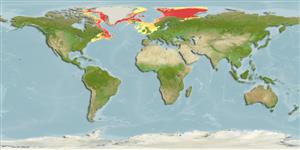
Northern Atlantic and the Arctic: Svalbard, Canadian Arctic Archipelago and Russia.
Longueur à la première maturité / Taille / Poids / Âge
Maturité: Lm ? range ? - ? cmâge max. reporté: 1.00 années (Réf. 130103)
Life span is less than 1 yr (Ref. 130103). Main food and feeding type based on another species of the same genus; to be replaced with a better reference (Ref. 96292). Found in soft bottom (Refs. 117328, 117453).
Cycle de vie et comportement reproducteur
Maturité | Reproduction | Frai | Œufs | Fécondité | Larves
Members of the order Cumacea are gonochoric and sexually dimorphic. Spawning is characterized by nocturnal swarming behavior. Females brood the eggs in the marsupium where they molt, become mancas and leave.
Piepenburg, D., N.V. Chernova, C.F. von Dorrien, J. Gutt, A.V. Neyelov, E. Rachor, L. Saldanha and M.K. Schmid 1996 Megabenthic communities in the waters around Svalbard. Polar Biol. 16:431-446. (Réf. 2952)
Statut dans la liste rouge de l'IUCN
(Réf. 130435: Version 2025-2 (Global))
statut CITES (Réf. 108899)
Not Evaluated
Not Evaluated
Menace pour l'homme
Utilisations par l'homme
FAO - Publication: search | FishSource |
Outils
Plus d'informations
Écologie trophiqueAliments (proies)
Composition du régime alimentaire
Consommation alimentaire
Prédateurs
Dynamique des populations PhysiologieConsommation d'oxygène
Liées à l'hommeTimbres, pièces de monnaie, divers
Sources Internet
Estimations basées sur des modèles
Résilience
(Ref. 69278): |
Haut, temps minimum de doublement de population inférieur à 15 mois (tmax<1) |
Vulnérabilité de la pêche
(Réf. 71543) |
(0 of 100). |
Catégorie de prix
(Réf. 80766): |
Unknown. |