Not assigned |
Not assigned |
Trichoplacidae
Milieu: milieu / Klimaatzone / Diepte / verspreidingsgebied
Ecologie
Benthic. Tropical
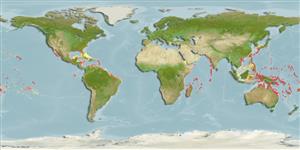
Circumglobal.
Lengte bij maturiteit / Grootte / Gewicht / Leeftijd
Maturiteit: Lm ? range ? - ? cm
Flat (up to 0.5mm in its longest dimension), multicellular, amorphous, mobile flagellated animal lacking body cavity, digestive and nervous systems, composed of 2 layers of epithelial cells. Associated glandular cells apparently secrete digestive enzymes beneath the animal as it sits atop the algae and protozoans on which it apparently feeds; digestion seems to be entirely extracellular , as there is no mouth and no sign of phagocytosis. The much thinner, upper layer of the animal bears flagellated cells, but no gland cells. In a sense, the upper layer is ectodermal, while the lower layer, because of its involvement in digesting food and absorbing nutrients, is endodermal. Between the upper and lower cell layers is a fluid-filled space containing a dense network of fibrous cells that may be contractile (Ref. 53).
Commonly found in warm marine environments (Ref. 57) and in marine aquaria (Ref. 59), on hard bottom substrates in the benthic regions (Ref. 53). A scavenger which feeds on dead animals with its ventral surface, which produces digestive enzymes (Ref. 53), and also feeds on Cryptomonas (Ref. 57 and 60) and algae (Ref. 59); often, individuals contract part of the ventral surface into a sac where digestion may take place more efficiently (Ref. 60).
Levenscyclus en paargedrag
Maturiteit | Voortplanting | Paaien | Eieren | Fecunditeit | Larven
Reproduces asexually, binary fission, budding (Ref. 60), fragmentation (Ref. 53). Older cultures at high density begin to produce small motile presumptive sperm cells, and as individual animals disintegrate, they spew out ova (Refs. 59, 61).
Collins, A.G. 2000 Intoduction to Placozoa. Tree of Life Web Project. http://www.ucmp.berkeley.edu/phyla/placozoa/placozoa.html (Ref. 60)
Status op de Rode Lijst van het IUCN
(Ref. 130435: Version 2025-2 (Global))
CITES status (Ref. 108899)
Not Evaluated
Not Evaluated
Gevaar voor de mens
Harmless
Gebruik door de mens
FAO - Publication: search | FishSource |
Tools
Meer informatie
PopulatiedynamicaGroei
Max. leeftijden / maten
Lengte-gewicht rel.
Lengte-lengte rel.
Lengtefrequenties
Massaconversie
Abundantie
LevenscyclusVoortplantingMaturiteitFecunditeitPaaienEierenOntwikkeling van de eierenLarven FysiologieZuurstofverbruik
Menselijk gerelateerdPostzegels, munten, diversen.
Internetbronnen
Schattingen op basis van modellen
Kwetsbaarheid van de visserij
(Ref. 71543) |
(0 of 100). |
Prijsklasse
(Ref. 80766): |
Unknown. |