Malacostraca |
Amphipoda |
Melitidae
Milieu: milieu / Klimaatzone / Diepte / verspreidingsgebied
Ecologie
Benthic; diepte 0 - 148 m (Ref. 108023). Temperate
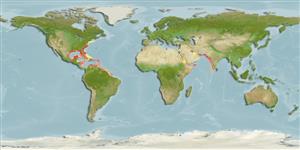
Western Indian Ocean and Western Atlantic: United Arab Emirates and USA.
Lengte bij maturiteit / Grootte / Gewicht / Leeftijd
Maturiteit: Lm ? range ? - ? cm Max length : 1.0 cm TL mannelijk / geslacht onbekend; (Ref. 118456); 1.11 cm TL (female)
Found on sponges, hydroids and bryozoans. Epibenthic. Polyhaline. Mesograzer on brown algae such as Sargassum (Ref. 75042).
Levenscyclus en paargedrag
Maturiteit | Voortplanting | Paaien | Eieren | Fecunditeit | Larven
This species has a semi-annual, iteroparous life history (Ref. 118456). Members of the order Amphipoda are gonochoric and sexually dimoprhic (males larger than females). Mating behavior: Males locate potential partners with the aid of their antenna to detect the pheromones released by the females; the male then rides or carries the female until the latter is ready to molt. When the female is ready, the male pushes the sperm into the marsupium and releases the female afterwards. A few hours later, the female releases her eggs into the marsupium for fertilization. Life cycle: Eggs are brooded in the marsupium. Eggs hatch into juveniles and remain in the marsupium for a few days. Each species undergo 20 molts at most, i.e., 1-year long life cycle (Ref. 833).
Lowry, J.K. and R.T. Springthorpe 2007 A revision of the tropical/temperate amphipod genus Dulichiella Stout, 1912, and the description of a new Atlantic genus Verdeia gen. nov. Zootaxa 1424:1-62. (Ref. 75042)
Status op de Rode Lijst van het IUCN
(Ref. 130435: Version 2025-2 (Global))
CITES status (Ref. 108899)
Not Evaluated
Not Evaluated
Gevaar voor de mens
Gebruik door de mens
FAO - Publication: search | FishSource |
Tools
Meer informatie
LevenscyclusVoortplantingMaturiteitFecunditeitPaaienEierenOntwikkeling van de eierenLarven FysiologieZuurstofverbruik
Menselijk gerelateerdPostzegels, munten, diversen.
Internetbronnen
Schattingen op basis van modellen
Kwetsbaarheid van de visserij
(Ref. 71543) |
Low vulnerability (10 of 100). |
Prijsklasse
(Ref. 80766): |
Unknown. |