Malacostraca |
Amphipoda |
Melitidae
Environnement : milieu / zone climatique / profondeur / gamme de distribution
Écologie
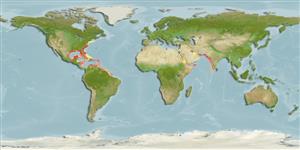
Benthic; profondeur 0 - 148 m (Réf. 108023). Temperate
Western Indian Ocean and Western Atlantic: United Arab Emirates and USA.
Longueur à la première maturité / Taille / Poids / Âge
Maturité: Lm ? range ? - ? cm Max length : 1.0 cm TL mâle / non sexé; (Réf. 118456); 1.11 cm TL (female)
Found on sponges, hydroids and bryozoans. Epibenthic. Polyhaline. Mesograzer on brown algae such as Sargassum (Ref. 75042).
Cycle de vie et comportement reproducteur
Maturité | Reproduction | Frai | Œufs | Fécondité | Larves
This species has a semi-annual, iteroparous life history (Ref. 118456). Members of the order Amphipoda are gonochoric and sexually dimoprhic (males larger than females). Mating behavior: Males locate potential partners with the aid of their antenna to detect the pheromones released by the females; the male then rides or carries the female until the latter is ready to molt. When the female is ready, the male pushes the sperm into the marsupium and releases the female afterwards. A few hours later, the female releases her eggs into the marsupium for fertilization. Life cycle: Eggs are brooded in the marsupium. Eggs hatch into juveniles and remain in the marsupium for a few days. Each species undergo 20 molts at most, i.e., 1-year long life cycle (Ref. 833).
Lowry, J.K. and R.T. Springthorpe 2007 A revision of the tropical/temperate amphipod genus Dulichiella Stout, 1912, and the description of a new Atlantic genus Verdeia gen. nov. Zootaxa 1424:1-62. (Réf. 75042)
Statut dans la liste rouge de l'IUCN
(Réf. 130435: Version 2025-2 (Global))
statut CITES (Réf. 108899)
Not Evaluated
Not Evaluated
Menace pour l'homme
Utilisations par l'homme
FAO - Publication: search | FishSource |
Outils
Plus d'informations
Dynamique des populationsCroissanceÂges / tailles maximalesLongueur-poids rel.Rel. longueur-longueur.Fréquences de longueursConversion de masseAbondance Cycle de vieReproductionMaturitéFéconditéFraiŒufsDéveloppement de l'œufLarves PhysiologieConsommation d'oxygène
Liées à l'hommeTimbres, pièces de monnaie, divers
Sources Internet
Estimations basées sur des modèles
Vulnérabilité de la pêche
(Réf. 71543) |
Low vulnerability (10 of 100). |
Catégorie de prix
(Réf. 80766): |
Unknown. |