Malacostraca |
Decapoda |
Crangonidae
Umwelt: Milieu / Klimazone / Tiefenbereich / Verbreitungsgebiet
Ökologie
Benthic; brackwasser; tiefenbereich 0 - 50 m (Ref. 434). Subtropical, preferred 11°C (Ref. 107945); 74°N - 23°N, 16°W - 44°W
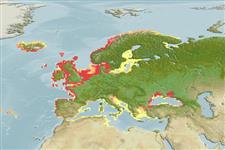
Northeast Atlantic and the Mediterranean.
Länge bei der ersten Reifung / Größe / Gewicht / Alter
Geschlechtsreife: Lm ? range ? - ? cm Max length : 8.9 cm TL Männchen/unbestimmt; (Ref. 434)
Found in both marine and oligohaline waters (Ref. 95752). Also inhabits brackish lagoons (Ref. 2779). Found on fine sand or slightly muddy sand (Ref. 434); also over coarse sand (Ref. 96391). Juveniles are epifaunal on seagrass and bare sand flats (Ref. 106879). Mobile (Refs. 95752, 96470). Free-living (Ref. 3123). Able to occupy areas with high exposure and low salinity (Ref. 95730). Carnivorous (Refs. 95752, 96470). Feeds on small benthic organisms (small crustaceans, annelids and mollusks) and fishery discards (Ref. 434).
Lebenszyklus und Paarungsverhalten
Geschlechtsreife | Fortpflanzung | Ablaichen | Eier | Fruchtbarkeit | Larven
Members of the order Decapoda are mostly gonochoric. Mating behavior: Precopulatory courtship ritual is common (through olfactory and tactile cues); usually indirect sperm transfer.
Fischer, W., G. Bianchi and W.B. Scott (eds.) 1981 Shrimps and prawns. 6: pag.var. In FAO species identification sheets for fishery purposes. Eastern Central Atlantic (Fishing Area 34, 47; in part). Canada Funds-in-Trust. Ottawa, Department of Fisheries and Oceans Canada, by arrangement with the Food and Agriculture organization of the United Nations. 1-7: pag.var. (Ref. 434)
IUCN Rote Liste Status
(Ref. 130435: Version 2025-2 (Global))
CITES Status (Ref. 108899)
Not Evaluated
Not Evaluated
Bedrohung für Menschen
Nutzung durch Menschen
Fischereien: kommerziell
FAO - Fischereien: Artbeschreibung, landings search; Publication: search | FishSource | Das Meer um uns herum
Tools
Mehr Information
MenschenbezogenBriefmarken, Münzen, Verschiedenes.
Internet Quellen
Schätzungen auf der Grundlage von Modellen
Widerstandsfähigkeit
(Ref. 69278): |
hoch, Verdopplung der Population dauert weniger als 15 Monate. (K=0.90-1.09) |
Anfälligkeit der Fischerei
(Ref. 71543) |
Low vulnerability (10 of 100). |
Klimaanfälligkeit
(Ref. 125649) |
Moderate vulnerability (37 of 100) |
Preiskategorie
(Ref. 80766): |
Very high. |
Nutrients
|
Calcium = 109 [35, 184] mg/100g; Iron = 1.59 [1.21, 1.97] mg/100g; Protein = 20.2 [19.2, 21.3] %; Omega3 = 0.285 [0.185, 0.386] g/100g; Selenium = 48.3 [-31.7, 128.3] μg/100g; VitaminA = 0 μg/100g; Zinc = 1.79 [1.17, 2.40] mg/100g (wet weight); based on nutrient studies. |