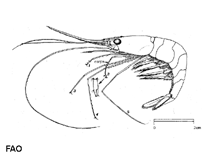
Malacostraca |
Decapoda |
Pandalidae
Umwelt: Milieu / Klimazone / Tiefenbereich / Verbreitungsgebiet
Ökologie
Benthopelagisch; tiefenbereich 165 - 2100 m (Ref. 97531), usually 400 - 600 m (Ref. 106425). Subtropical; 56°N - 51°S, 161°W - 180°E
Cosmopolitan: Western Atlantic: off South Carolina to Florida and off Bermuda; NE and SW Gulf of Mexico. Eastern Atlantic: off SW Ireland, Bay of Biscay, throughout Mediterranean, Gulf of Guinea, and Cape of Good Hope. Indo-West Pacific: from Gulf of Aden and east African coast to Japan and Hawaii; Plesionika martia orientalis: Indo-Pacific.
Länge bei der ersten Reifung / Größe / Gewicht / Alter
Geschlechtsreife: Lm 1.6 range ? - ? cm Max length : 16.9 cm TL Männchen/unbestimmt; (Ref. 434)
Also caught by pelagic trawls (Ref. 417). Minimum depth from Ref. 80357. Benthic species inhabiting muddy bottoms (Ref. 434), soft mud and coarse sand at depths of 176 to 700 m (Ref. 80357). Benthopelagic (Ref. 91956). Feeds on crustaceans (Pasyphaeidae, euphausiids) and carrion (Ref. 434).
Members of the order Decapoda are mostly gonochoric. Mating behavior: Precopulatory courtship ritual is common (through olfactory and tactile cues); usually indirect sperm transfer.
Fischer, W., G. Bianchi and W.B. Scott (eds.) 1981 Shrimps and prawns. 6: pag.var. In FAO species identification sheets for fishery purposes. Eastern Central Atlantic (Fishing Area 34, 47; in part). Canada Funds-in-Trust. Ottawa, Department of Fisheries and Oceans Canada, by arrangement with the Food and Agriculture organization of the United Nations. 1-7: pag.var. (Ref. 434)
IUCN Rote Liste Status
(Ref. 130435: Version 2025-2 (Global))
CITES Status (Ref. 108899)
Not Evaluated
Not Evaluated
Bedrohung für Menschen
Nutzung durch Menschen
Fischereien: kommerziell
FAO - Publication: search | FishSource |
Tools
Mehr Information
PhysiologieSauerstoffverbrauch
MenschenbezogenBriefmarken, Münzen, Verschiedenes.
Internet Quellen
Schätzungen auf der Grundlage von Modellen
Widerstandsfähigkeit
(Ref. 69278): |
hoch, Verdopplung der Population dauert weniger als 15 Monate. (K=0.31-0.73) |
Anfälligkeit der Fischerei
(Ref. 71543) |
Low vulnerability (25 of 100). |
Preiskategorie
(Ref. 80766): |
Very high. |