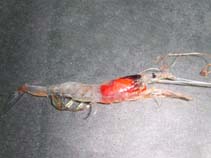
Malacostraca |
Decapoda |
Sergestidae
Umwelt: Milieu / Klimazone / Tiefenbereich / Verbreitungsgebiet
Ökologie
Bathypelagisch; tiefenbereich 180 - 4500 m (Ref. 80197). Subtropical; 76°N - 60°S, 180°W - 180°E
Indo-Pacific, Atlantic, Mediterranean, Arctic and Antarctic: from Juan Fernandez (Chile), Chatham Islands, off New Zealand, south of Australia, and west to Amsterdam Island and Prince Edward Islands; Eastern Atlantic from Greenland, Iceland, Faeroe Islands, Norway, United Kingdom, Ireland, Spain, Morocco, into the Mediterranean, south to Gabon, Angola and South Africa, including Canary Islands; Western Atlantic from Greenland, Canada, USA to Uruguay, Argentina, Chile in the Magellan Strait and Falkland Islands. Polar to tropical.
Länge bei der ersten Reifung / Größe / Gewicht / Alter
Geschlechtsreife: Lm ? range ? - ? cm Max length : 1.4 cm CL Männchen/unbestimmt; (Ref. 80197)
Maximum depth from Ref. 85542. Daytime depth is 600 to 960 meters (Ref. 96715). Feeds on calanoid copepods and chaetognaths (Ref. 85542).
Lebenszyklus und Paarungsverhalten
Geschlechtsreife | Fortpflanzung | Ablaichen | Eier | Fruchtbarkeit | Larven
Members of the order Decapoda are mostly gonochoric. Mating behavior: Precopulatory courtship ritual is common (through olfactory and tactile cues); usually indirect sperm transfer.
Pérez Farfante, I. and B. Kensley 1997 Penaeoid and Sergestoid shrimps and prawns of the world: keys and diagnoses for the families and genera. Mémoires du Muséum National d'Histoire Naturelle 175:1-233. (Ref. 75620)
IUCN Rote Liste Status
(Ref. 130435: Version 2025-2 (Global))
CITES Status (Ref. 108899)
Not Evaluated
Not Evaluated
Bedrohung für Menschen
Nutzung durch Menschen
FAO - Publication: search | FishSource |
Tools
Mehr Information
LebenszyklusFortpflanzungGeschlechtsreifeFruchtbarkeitAblaichenEierEientwicklungLarven PhysiologieSauerstoffverbrauch
MenschenbezogenBriefmarken, Münzen, Verschiedenes.
Internet Quellen
Schätzungen auf der Grundlage von Modellen
Widerstandsfähigkeit
(Ref. 69278): |
hoch, Verdopplung der Population dauert weniger als 15 Monate. (K=0.7-0.8) |
Anfälligkeit der Fischerei
(Ref. 71543) |
Low vulnerability (13 of 100). |
Preiskategorie
(Ref. 80766): |
Very high. |