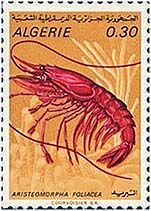
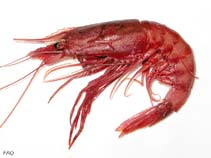
Malacostraca |
Decapoda |
Aristeidae
Milieu: milieu / Klimaatzone / Diepte / verspreidingsgebied
Ecologie
Benthopelagisch; diepte 60 - 1300 m (Ref. 97594), usually 250 - 750 m (Ref. 409). Tropical; ? - 14°C (Ref. 434), preferred 20°C (Ref. 107945); 55°N - 55°S, 180°W - 180°E
Atlantic, the Mediterranean and Indo-Pacific. Tropical to temperate.
Lengte bij maturiteit / Grootte / Gewicht / Leeftijd
Maturiteit: Lm 3.7, range 3 - 4.414 cm Max length : 17.0 cm TL mannelijk / geslacht onbekend; (Ref. 104052); 22.5 cm TL (female); max. gepubliceerd gewicht: 45.90 g (Ref. 126095); max. gepubliceerd gewicht: 45.90 g; max. gerapporteerde leeftijd: 8 Jaren (Ref. 80203)
Deep-water benthopelagic shrimp (Ref. 87'>114287). Common total length: 12 to 16 cm. Minimum common depth from Ref. 8. Usually caught on muddy and sandy bottoms of continental slopes (Ref. 434). Lives on bottom mud (Ref. 8); also on sandy bottoms. Moves to midwater at night (Ref. 409). Carnivorous, feeds mainly on euphausiids and other species of crustaceans, i.e., mainly Natantia sp. (Ref. 434). Has a highly diversified diet (Refs. 97770, 105137), preying on pelagic, benthic and benthopelagic organisms (Ref. 105137); mainly forages on crustaceans and fish. Also scavenges upon carcasses of fish and cephalopods on the bottom (Ref. 97770). Exhibits cannibalism. Values of δ15N ranges from 6.68 and 7.96 in females, and 7.05 and 8.26 in males, with females having higher δ15N with increasing size (Ref. 105135).
Levenscyclus en paargedrag
Maturiteit | Voortplanting | Paaien | Eieren | Fecunditeit | Larven
Spawning occurs during spring to summer. Females have a life span of 7-8 years while males live for 5-6 years.
Pérez Farfante, I. and B. Kensley 1997 Penaeoid and Sergestoid shrimps and prawns of the world: keys and diagnoses for the families and genera. Mémoires du Muséum National d'Histoire Naturelle 175:1-233. (Ref. 75620)
Status op de Rode Lijst van het IUCN
(Ref. 130435: Version 2025-2 (Global))
CITES status (Ref. 108899)
Not Evaluated
Not Evaluated
Gevaar voor de mens
Gebruik door de mens
Visserij: commercieel
FAO - visserij: landings search; Publication: search | FishSource | Sea Around Us
Tools
Meer informatie
FysiologieZuurstofverbruik
Internetbronnen
Schattingen op basis van modellen
Weerstandsvermogen
(Ref. 69278): |
Hoog, minimale populatieverdubbelingstijd minder dan 15 maanden (K=0.37-0.96; tm=1.5; tmax=8) |
Rate of population increase
|
Prior r = 0.77, 95% CL = 0.51 - 1.16, Based on 4 full stock assessments. |
Kwetsbaarheid van de visserij
(Ref. 71543) |
Low to moderate vulnerability (27 of 100). |
Kwetsbaarheid voor het klimaat
(Ref. 125649) |
Moderate to high vulnerability (48 of 100) |
Prijsklasse
(Ref. 80766): |
Very high. |
Nutrients
|
Calcium = 109 [35, 184] mg/100g; Iron = 1.59 [1.21, 1.97] mg/100g; Protein = 20.2 [19.2, 21.3] %; Omega3 = 0.285 [0.185, 0.386] g/100g; Selenium = 48.3 [-31.7, 128.3] μg/100g; VitaminA = 0 μg/100g; Zinc = 1.79 [1.17, 2.40] mg/100g (wet weight); based on nutrient studies. |