Malacostraca |
Decapoda |
Stenopodidae
Environnement : milieu / zone climatique / profondeur / gamme de distribution
Écologie
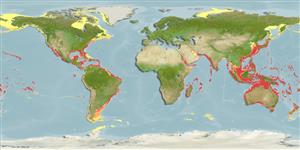
Benthic; profondeur 1 - 200 m (Réf. 96667). Tropical; 43°N - 42°S, 180°W - 180°E
Indo-Pacific and Western Atlantic: From the Red Sea and South Africa to Tuamotu Is., Hawaii and Easter Is. In the Atlantic: North Carolina and Bermuda to the Caribbean Sea and south to São Paulo, Brazil. Tropical and subtropical.
Longueur à la première maturité / Taille / Poids / Âge
Maturité: Lm ? range ? - ? cm
Description synthétique
Morphologie
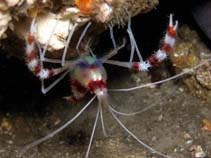
The carapace, abdomen, and claws are covered with tiny spines. Red and white bands are also present on the body and claws, with the bands sometimes bordered in purple. Two pairs of long, white antennae also present.
Maximum depth from Ref. 97531. Subtidal (Ref. 106854). Found on rocky bottoms and coral reefs (Ref. 83922). Also occur at natural depressions in rock formations (Ref. 126252). General carnivore (Ref. 116259). Feed mainly on small arthropods and other marine invertebrates. Considered as a cleaner shrimp, removing and consuming parasites, injured tissue, and leftover food particles from other reef fishes (Ref. 125532). Dwells in deep crevices and reef overhangs (Ref. 129713).
Cycle de vie et comportement reproducteur
Maturité | Reproduction | Frai | Œufs | Fécondité | Larves
Members of the order Decapoda are mostly gonochoric (Ref. 833). Mating behavior occurs in the following sequence: antennule contact, erection of female body, grasping, mating and spawning (Ref. 107136).
Williams, A.B., L.G. Abele, D.L. Felder, H.H. Hobbs Jr., R.B. Manning, P.A. McLaughlin and I. Pérez Farfante 1988 Common and scientific names of aquatic invertebrates from the United States and Canada: decapod crustaceans. American Fisheries Society Special Publication 17. 77 pp. + 12 figs. (Réf. 2214)
Statut dans la liste rouge de l'IUCN
(Réf. 130435: Version 2025-2 (Global))
statut CITES (Réf. 108899)
Not Evaluated
Not Evaluated
Menace pour l'homme
Utilisations par l'homme
Pêcheries: commercial
FAO - Publication: search | FishSource |
Outils
Plus d'informations
Écologie trophiqueAliments (proies)Composition du régime alimentaireConsommation alimentairePrédateurs Dynamique des populationsCroissance
Âges / tailles maximales
Longueur-poids rel.
Rel. longueur-longueur.
Fréquences de longueurs
Conversion de masse
Abondance
PhysiologieConsommation d'oxygène
Liées à l'hommeTimbres, pièces de monnaie, divers
Sources Internet
Estimations basées sur des modèles
Vulnérabilité de la pêche
(Réf. 71543) |
(0 of 100). |
Catégorie de prix
(Réf. 80766): |
Unknown. |