Malacostraca |
Decapoda |
Stenopodidae
Entorno: milieu / zona climática / rango de profundidad / gama de distribución
Ecología
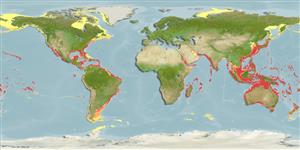
Benthic; rango de profundidad 1 - 200 m (Referencia 96667). Tropical; 43°N - 42°S, 180°W - 180°E
Indo-Pacific and Western Atlantic: From the Red Sea and South Africa to Tuamotu Is., Hawaii and Easter Is. In the Atlantic: North Carolina and Bermuda to the Caribbean Sea and south to São Paulo, Brazil. Tropical and subtropical.
Longitud en la primera madurez / Tamaño / Peso / Edad
Madurez: Lm ? range ? - ? cm
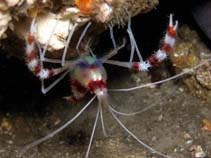
The carapace, abdomen, and claws are covered with tiny spines. Red and white bands are also present on the body and claws, with the bands sometimes bordered in purple. Two pairs of long, white antennae also present.
Maximum depth from Ref. 97531. Subtidal (Ref. 106854). Found on rocky bottoms and coral reefs (Ref. 83922). Also occur at natural depressions in rock formations (Ref. 126252). General carnivore (Ref. 116259). Feed mainly on small arthropods and other marine invertebrates. Considered as a cleaner shrimp, removing and consuming parasites, injured tissue, and leftover food particles from other reef fishes (Ref. 125532). Dwells in deep crevices and reef overhangs (Ref. 129713).
Ciclo vital y comportamiento de apareamiento
Madurez | Reproducción | Puesta | Huevos | Fecundidad | Larva
Members of the order Decapoda are mostly gonochoric (Ref. 833). Mating behavior occurs in the following sequence: antennule contact, erection of female body, grasping, mating and spawning (Ref. 107136).
Williams, A.B., L.G. Abele, D.L. Felder, H.H. Hobbs Jr., R.B. Manning, P.A. McLaughlin and I. Pérez Farfante 1988 Common and scientific names of aquatic invertebrates from the United States and Canada: decapod crustaceans. American Fisheries Society Special Publication 17. 77 pp. + 12 figs. (Referencia 2214)
Situación en la Lista Roja de la UICN
(Referencia 130435: Version 2025-2 (Global))
Estatus CITES (Referencia 108899)
Not Evaluated
CMS (Referencia 116361)
Not Evaluated
Amenaza para el ser humano
Usos humanos
Pesquerías: comercial
FAO - Publication: search | FishSource |
Herramientas
Más información
Ecología TróficaAlimentos (presas)Composición de la dietaconsumo de alimentoDespredadores Dinámica de la poblaciónCrecimiento
Edades / tallas máximas
Longitud-peso rel.
Longitud-longitud rel.
Longitud-frecuencias
Conversión de masas
Abundancia
FisiologíaConsumo del oxígeno
Relacionados con el ser humanoSellos, monedas, varios
Fuentes de Internet
Estimaciones basadas en modelos
Vulnerabilidad pesquera
(Referencia 71543) |
(0 of 100). |
Categoría de precios
(Referencia 80766): |
Unknown. |