Malacostraca |
Decapoda |
Pandalidae
Umwelt: Milieu / Klimazone / Tiefenbereich / Verbreitungsgebiet
Ökologie
Benthic; tiefenbereich 5 - 501 m (Ref. 8). Temperate, preferred 5°C (Ref. 107945); 63°N - 33°N, 126°E - 122°W
Northern Pacific and Northwest Atlantic: From Korea Strait, Japan and West Bering Sea to Kuril Islands, Gulf of Alaska and Puget Sound, Washington, USA.
Länge bei der ersten Reifung / Größe / Gewicht / Alter
Geschlechtsreife: Lm ? range ? - ? cm Max length : 20.9 cm TL Männchen/unbestimmt; (Ref. 8)
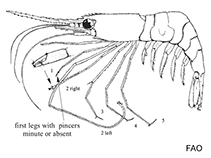
Known as "king", "rose", or "hump", it is superficially similar to P. danae except that it is blotched, redder in color and larger. As in P. danae the body is stout and the shell hard, but the surface is smooth and the carapace strongly arched dorsally. There are 17 to 22 dorsal spines which occupy the anterior three fifths of the carapace and extend an equal distance on the rostrum. The distal portion of the rostrum is strongly ascending and unarmed, except at the tip, which is oblique and armed with three immovable spines.
Maximum depth from Ref. 116014.
Lebenszyklus und Paarungsverhalten
Geschlechtsreife | Fortpflanzung | Ablaichen | Eier | Fruchtbarkeit | Larven
Male yearlings (March-May) reach their sexual maturity by fall. Metamorphosis occur in spring and in shallow water (20-30 fathoms) around 2 years of age, females mature few months after (September) where spawning starts. Eggs were found by April (Ref. 82652).
Williams, A.B., L.G. Abele, D.L. Felder, H.H. Hobbs Jr., R.B. Manning, P.A. McLaughlin and I. Pérez Farfante 1988 Common and scientific names of aquatic invertebrates from the United States and Canada: decapod crustaceans. American Fisheries Society Special Publication 17. 77 pp. + 12 figs. (Ref. 2214)
IUCN Rote Liste Status
(Ref. 130435: Version 2025-2 (Global))
CITES Status (Ref. 108899)
Not Evaluated
Not Evaluated
Bedrohung für Menschen
Nutzung durch Menschen
Fischereien: kommerziell
FAO - Fischereien: landings search; Publication: search | FishSource | Das Meer um uns herum
Tools
Mehr Information
Trophische ÖkologieLebensmittel (Beutetiere)NahrungszusammensetzungNahrungsaufnahmeRäuber PhysiologieSauerstoffverbrauch
MenschenbezogenBriefmarken, Münzen, Verschiedenes.
Internet Quellen
Schätzungen auf der Grundlage von Modellen
Anfälligkeit der Fischerei
(Ref. 71543) |
Low vulnerability (11 of 100). |
Klimaanfälligkeit
(Ref. 125649) |
Moderate vulnerability (36 of 100) |
Preiskategorie
(Ref. 80766): |
Very high. |
Nutrients
|
Calcium = 109 [35, 184] mg/100g; Iron = 1.59 [1.21, 1.97] mg/100g; Protein = 20.2 [19.2, 21.3] %; Omega3 = 0.285 [0.185, 0.386] g/100g; Selenium = 48.3 [-31.7, 128.3] μg/100g; VitaminA = 0 μg/100g; Zinc = 1.79 [1.17, 2.40] mg/100g (wet weight); based on nutrient studies. |