Malacostraca |
Decapoda |
Upogebiidae
สิ่งแวดล้อม : สิ่งแวดล้อม / เขตภูมิอากาศ / ระดับความลึก / ระยะการกระจายสินค้า
นิเวศวิทยา
Benthic; กร่อย; ระดับความลึก 0 - 1 m (อ้างอิง 4). Temperate, preferred 9°C (อ้างอิง 107945); 62°N - 35°N, 152°W - 120°W (อ้างอิง 4)
Eastern Pacific: Prince William Sound, Alaska to Morro Bay, California, USA.
ความยาวเมื่อครบกำหนดครั้งแรก / ขนาด / น้ำหนัก / อายุ
วัยเจริญพันธุ์: Lm ? range ? - ? cm Max length : 15.0 cm TL เพศผู้/กระเทย; (อ้างอิง 4); 10.5 cm TL (female)
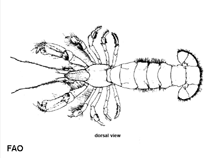
Rostrum ending in three teeth, the median tooth broad and triangular, the lateral teeth much shorter. A groove between the median and lateral teeth, also a very shallow median longitudinal groove. Lower surface of rostrum without spines. Anterolateral border of carapace with a very small tooth at the level of the eye. First pereiopods subchelate. Dactylus of adult male on inner surface with a longitudinal row of 6-12 tubercles, that are placed close together. Carpus with some anterior spines. Merus with a subdistal anterodorsal spine (Ref. 4).
It has lengths of 11 cm, total body length (Ref. 259); 15 cm (males) and 10.5 cm (females), total length (Refs. 4, 258). It burrows in muddy sand of the intertidal zone, sometimes under rocks; burrows are Y-shaped, and about 0.6 to 1 m deep (Ref. 4). Found in bays and estuaries (Ref. 112892).
วงจรชีวิตและพฤติกรรมการผสมพันธุ์
วัยเจริญพันธุ์ | การสืบพันธุ์ | การวางไข่ | เซลสืบพันธ์ของเพศเมีย(ไข่) | ความดกของไข่ | ตัวอ่อน
Members of the order Decapoda are mostly gonochoric. Mating behavior: Precopulatory courtship ritual is common (through olfactory and tactile cues); usually indirect sperm transfer.
Holthuis, L.B. 1991 FAO Species Catalogue. Vol. 13. Marine lobsters of the world. An annotated and illustrated catalogue of species of interest to fisheries known to date. FAO Fish. Synop. 125(13):292p. Rome: FAO. (อ้างอิง 4)
สถานะบัญชีแดงของ IUCN
(อ้างอิง 130435: Version 2025-2 (Global))
สถานะไซเตส (อ้างอิง 108899)
Not Evaluated
CMS (อ้างอิง 116361)
Not Evaluated
ภัยคุกคามต่อมนุษย์
การใช้ของมนุษย์
การประมง: การค้า; เหยื่อ: occasionally
FAO - การประมง: landings search; Publication: search | FishSource | ทะเลรอบๆเรา
เครื่องมือ
ข้อมูลเพิ่มเติม
พลวัตของประชากรการเจริญเติบโต
อายุสูงสุด / ขนาด
ความยาว-น้ำหนักสัมพันธ์
ความยาว-ความยาวสัมพันธ์
ความยาว-ความถี่
การแปลงมวล
อุดมสมบรูณ์
เกี่ยวข้องกับมนุษย์แสตมป์ เหรียญ อื่นๆ
แหล่งที่มาจากอินเตอร์เน็ต
การประมาณค่าตามแบบจำลอง
ความเสี่ยงต่อการตกปลา
(อ้างอิง 71543) |
Low vulnerability (10 of 100). |
ความเสี่ยงต่อสภาพภูมิอากาศ
(อ้างอิง 125649) |
High to very high vulnerability (71 of 100) |
หมวดหมู่ราคา
(อ้างอิง 80766): |
Very high. |
Nutrients
|
Calcium = 109 [35, 184] mg/100g; Iron = 1.59 [1.21, 1.97] mg/100g; Protein = 20.2 [19.2, 21.3] %; Omega3 = 0.285 [0.185, 0.386] g/100g; Selenium = 48.3 [-31.7, 128.3] μg/100g; VitaminA = 0 μg/100g; Zinc = 1.79 [1.17, 2.40] mg/100g (wet weight); based on nutrient studies. |