Malacostraca |
Decapoda |
Cancridae
पर्यावरण: पर्यावरण / जलवायु क्षेत्र / गहराई सीमा / वितरण सीमा
पारिस्थितिकी
Benthic; गहराई सीमा 0 - 575 m (संदर्भ 367). Temperate, preferred 20°C (संदर्भ 107945); 53°N - 25°N, 81°W - 43°W
Western Atlantic.
प्रथम परिपक्वता पर लंबाई / आकार / वज़न / आयु
परिपक्व अवधि: Lm ? range ? - ? cm Max length : 8.9 cm CW (female); अधिकतम प्रकाशित वज़न: 0.00 g
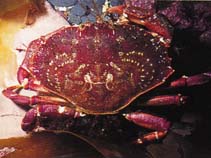
Carapace approximately 2/3 long as wide, convex, granulated; front with 3 teeth, middle one exceeding others and depressed (flattened dorsoventrally); anterolateral margins (excluding inner orbital angles) divided into 9 lobes or teeth with edges granulate; notches between teeth continued on carapace as short, closed fissures giving teeth a pentagonal character. Pincers moderate-sized, shorter than second legs, ridges granulated carpus with sharp inner dorsal spine. Color: yellowish, closely dotted with dark purplish brown, becoming reddish brown after death.
Minimum depth from Ref. 97531. Occurs at depths ranging from the low-water mark to 575 m. Basically a cold water species. Small to medium-sized crabs move into shallower depths especially in winter, whereas larger ones occur in deeper waters (Ref. 367). Found on molluscan and other shells (Ref. 97531). Feeds mainly on mollusks, echinoderms, and other invertebrates (Ref. 367).
जीवन चक्र और संभोग व्यवहार
परिपक्व अवधि | पुनरुत्पत्ति | मछलीऔ का अंडे देना | अंडे | उपजाऊपन | लार्वा
Members of the order Decapoda are mostly gonochoric. Mating behavior: Precopulatory courtship ritual is common (through olfactory and tactile cues); usually indirect sperm transfer.
Tavares, M. 2003 True Crabs. pp. 327-352. In Carpenter, K.E. (ed.) The living marine resources of the Western Central Atlantic. Volume1: introdution, molluscs, crustaceans, hagfishes, sharks, batoid fishes, and chimaeras. FAO Species Identification Guide for Fishery Purposes and American Society of Ichthyologists and Herpetologists Special PublicationNo. 5. Rome, FAO. pp. 1-600. (संदर्भ 367)
आईयूसीएन रेड लिस्ट स्थिति
(संदर्भ 130435: Version 2025-2 (Global))
CITES स्थिति (संदर्भ 108899)
Not Evaluated
CMS (संदर्भ 116361)
Not Evaluated
मनुष्यों के लिए ख़तरा
मानव उपयोग
मात्स्यिकी: व्यापारिक
FAO - Publication: search | FishSource | हमारे चारों ओर समुद्र
साधन
अधिक जानकारी
जीवन चक्रपुनरुत्पत्तिपरिपक्व अवधिउपजाऊपनमछलीऔ का अंडे देनाअंडेअंडे का विकासलार्वा फिजियोलॉजीप्राणवायु की खपत
मानव संबंधीटिकट, सिक्के, विविध.
इंटरनेट स्रोत
मॉडल पर आधारित अनुमान
मछली पकड़ने की भेद्यता
(संदर्भ 71543) |
Low vulnerability (10 of 100). |
जलवायु भेद्यता
(संदर्भ 125649) |
Low to moderate vulnerability (33 of 100) |
मूल्य श्रेणी
(संदर्भ 80766): |
Very high. |
Nutrients
|
Calcium = 109 [35, 184] mg/100g; Iron = 1.59 [1.21, 1.97] mg/100g; Protein = 20.2 [19.2, 21.3] %; Omega3 = 0.285 [0.185, 0.386] g/100g; Selenium = 48.3 [-31.7, 128.3] μg/100g; VitaminA = 0 μg/100g; Zinc = 1.79 [1.17, 2.40] mg/100g (wet weight); based on nutrient studies. |