Malacostraca |
Decapoda |
Portunidae
Environnement : milieu / zone climatique / profondeur / gamme de distribution
Écologie
Benthopélagique; dH range: 27.5 - 35; profondeur 0 - 68 m (Réf. 97531). Tropical; 43°N - 41°S, 98°W - 34°W
Western Atlantic: USA to Argentina.
Longueur à la première maturité / Taille / Poids / Âge
Maturité: Lm ? range ? - ? cm Max length : 14.1 cm CW mâle / non sexé; (Réf. 367)
Description synthétique
Morphologie
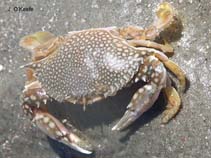
Carapace more than twice as broad as long; 9 teeth on broadly arched anterolateral margin (outer orbital tooth and strong lateral spine included); front not so advanced as outer orbital teeth, bearing, between the inner orbital angles, one pair of bicuspid teeth (resulting from the coalition of 2 separate pairs). Convex dorsal surface finely granulate, fissures on orbital margin broadly open; lower surface of carapace hairy; pincers moderate-sized; legs rather short and broad, densely fringed with hairs; fifth legs flattened in form of paddles. Basal segment of abdomen produced on each side into a strong, sharp, slightly upcurved spine. Color: dorsal surface, including pincers, light reddish brown to olive brown covered with many small, rounded white spots, tips of walking legs yellow; color pattern persisting in alcohol.
Minimum carapace width: 2.28 cm (Ref. 93549). Inhabits shallow water along ocean sand beaches and is well adapted to life in the waves and shifting sand; usually in bottom burrows at daytime and emerges at night, at temperatures of 27.5 to 28.6°C and salinities of 27.5 to 35 ppt. Presumably feeds on a variety of items including mollusks, other bottom invertebrates, and some fishes, carrion and detritus (Ref. 367).
Cycle de vie et comportement reproducteur
Maturité | Reproduction | Frai | Œufs | Fécondité | Larves
Ovigerous females have been reported from May to September.
Tavares, M. 2003 True Crabs. pp. 327-352. In Carpenter, K.E. (ed.) The living marine resources of the Western Central Atlantic. Volume1: introdution, molluscs, crustaceans, hagfishes, sharks, batoid fishes, and chimaeras. FAO Species Identification Guide for Fishery Purposes and American Society of Ichthyologists and Herpetologists Special PublicationNo. 5. Rome, FAO. pp. 1-600. (Réf. 367)
Statut dans la liste rouge de l'IUCN
(Réf. 130435: Version 2025-2 (Global))
statut CITES (Réf. 108899)
Not Evaluated
Not Evaluated
Menace pour l'homme
Utilisations par l'homme
Pêcheries: intérêt commercial mineur
FAO - Publication: search | FishSource |
Outils
Plus d'informations
Dynamique des populationsCroissanceÂges / tailles maximalesLongueur-poids rel.Rel. longueur-longueur.Fréquences de longueursConversion de masseAbondance Cycle de vieReproductionMaturitéFéconditéFraiŒufsDéveloppement de l'œufLarves PhysiologieConsommation d'oxygène
Liées à l'hommeTimbres, pièces de monnaie, divers
Sources Internet
Estimations basées sur des modèles
Vulnérabilité de la pêche
(Réf. 71543) |
Low vulnerability (10 of 100). |
Catégorie de prix
(Réf. 80766): |
Unknown. |