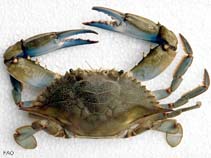
Malacostraca |
Decapoda |
Portunidae
Окружающая среда: среда / климатическая зона / пределы глубины / диапазон распространения
экология
донно-пелагический; пресноводный; солоноватоводный; пределы глубины 0 - 90 m (ссылка 109245), usually 0 - 35 m (ссылка 367). Tropical; 6°C - 30°C (ссылка 105839), preferred 25°C (ссылка 107945); 47°N - 39°S, 98°W - 34°W
Western Atlantic: From Nova Scotia, west to Gulf of Mexico and south to Puerto Quequén, Argentina. Introduced in the Eastern Atlantic, Mediterranean Sea, Black Sea and Indo-Pacific. Tropical to temperate.
Длина при первой зрелости / Размер / Вес / Возраст
половая зрелость: Lm 12.8, range 13 - 13 cm Max length : 22.7 cm WD самец/пол неопределен; (ссылка 367); наибольший возраст (опубликованны данные): 3.00 годы (ссылка 105839)
Carapace more than twice as broad as long; 9 blunt to acuminate teeth (outer orbital tooth and strong lateral spine included) on arched anterolateral margin; front (excluding inner orbital angles) bearing 2 obtuse to acuminate, broadly triangular teeth with often sinuous inner margins longer than outer margins. Much of convex dorsal surface smooth, but scattered and transverse lines of fine granules; sculpture of regions near center varying from low and smooth to rather sharply raised relief with crowded granules; pincers strong, dissimilar, and ridged longitudinally; fifth legs flattened in form of paddles. Males with T-shaped abdomen level of thoracic sternite 4; slender first pleopods with membranous tip reaching beyond suture between thoracic sternites 4 and 5; sinuously curved overlapping proximally and armed distally with a row of large and small retrogressive spinules. Color: greyish, bluish, or brownish green. Males with propodi of chelae blue on inner and white on outer surfaces, fingers blue on inner and white on outer surfaces and tipped with red. Mature females with orange fingers on chelae tipped with purple. Underparts off-white with tints of yellow and pink. Color variations is associated with sexual dimorphism and molt cycle.
An epibenthic omnivore, that is active and abundant in shallow habitats (Ref. 087949). Longevity was estimated from a population of blue crabs in Chesapeake Bay (Ref. 105839). Benthopelagic (Ref. 97531). Hatching occurs in mouths of estuaries and shallow marine waters, development of larvae progresses in the ocean, followed by migration of megalopae and young crabs back into estuarine waters to mature into adults (Ref. 367). Found on soft bottoms (Ref. 106866). Burrows in muddy-sand bottoms (Ref. 108781). Juveniles occur on seagrasses. Highly cannibalistic; adult conspecifics are observed attacking tethered juveniles (Ref. 106866). Appears to be an opportunistic feeder (Refs. 108779, 137615). Euryhaline (Refs.137615, 137620) and eurythermal (Ref. 137620). Inhabits bays and estuaries, in habitats with sandy substrates. Common at depths of 35m but can reach up to 90m deep. Can migrate upstream. Prefers to feed mollusks but also eats their juveniles, plants, fish, polychaetes and other crustaceans (Ref. 137615). Adult males prefer brackish water while adult females prefer waters with high salinity (>30ppt). Juveniles more tolerant to various salinities and temperatures (Ref. 137620).
Members of the order Decapoda are mostly gonochoric. Mating behavior: Precopulatory courtship ritual is common (through olfactory and tactile cues); usually indirect sperm transfer.
Основная ссылка
ссылки | координатор | соавторы
Tavares, M. 2003 True Crabs. pp. 327-352. In Carpenter, K.E. (ed.) The living marine resources of the Western Central Atlantic. Volume1: introdution, molluscs, crustaceans, hagfishes, sharks, batoid fishes, and chimaeras. FAO Species Identification Guide for Fishery Purposes and American Society of Ichthyologists and Herpetologists Special PublicationNo. 5. Rome, FAO. pp. 1-600. (ссылка 367)
Статус Красного Списка МСОП
(ссылка 130435: Version 2025-2 (Global))
Статус СИТЕС (ссылка 108899)
Not Evaluated
CMS (ссылка 116361)
Not Evaluated
Угроза для людей
Использование человеком
рыболовство: коммерческий
FAO - Aquaculture Systems: production searchрыболовство: Видовой профиль, landings search; Publication: search | FishSource | Море вокруг нас
инструменты
дополнительная информация
Динамика численности населения Связанные с человекомМарки, монеты и прочее.
Информационно-просветительская работа
ресурсы в Интернет
Оценки, основанные на моделях
устойчивость к внешним воздействиям
(Ref. 69278): |
высокий, минимальное время удвоения популяции до 15 месяцев (K=0.5-1.59; tmax=3) |
Rate of population increase
|
Prior r = 0.89, 95% CL = 0.59 - 1.34, Based on 2 full stock assessments. |
Уязвимость рыбной ловли
(ссылка 71543) |
Low vulnerability (16 of 100). |
Климатическая уязвимость
(ссылка 125649) |
Low to moderate vulnerability (33 of 100) |
Категория цены
(ссылка 80766): |
Very high. |
Nutrients
|
Calcium = 109 [35, 184] mg/100g; Iron = 1.59 [1.21, 1.97] mg/100g; Protein = 20.2 [19.2, 21.3] %; Omega3 = 0.285 [0.185, 0.386] g/100g; Selenium = 48.3 [-31.7, 128.3] μg/100g; VitaminA = 0 μg/100g; Zinc = 1.79 [1.17, 2.40] mg/100g (wet weight); based on nutrient studies. |