Malacostraca |
Decapoda |
Portunidae
Entorno: milieu / zona climática / rango de profundidad / gama de distribución
Ecología
Bentopelágico; rango de profundidad 0 - 75 m (Referencia 367). Tropical; 18°C - 31°C (Referencia 367); 38°N - 34°S, 94°W - 32°W
Western Atlantic: USA to Brazil. Tropical to subtropical.
Longitud en la primera madurez / Tamaño / Peso / Edad
Madurez: Lm 3.8 range ? - ? cm Max length : 13.0 cm CW macho / no sexado; (Referencia 367); 11 cm CW (female); edad máxima reportada: 2.40 años (Referencia 85497)
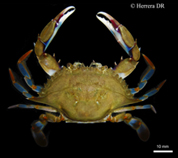
Carapace slightly more than twice as broad as long; 9 teeth on arched anterolateral margin (outer orbital tooth and strong lateral spine included) progressively more acuminate laterally; outer pair of frontal teeth (excluding inner orbital angles) prominent but inner pair small, often almost completely rudimentary. Much of convex dorsal surface lightly granulate, most prominently so on anterior and elevated areas and in transverse lines; central trapezoidal (metagastric) area short and wide (anterior width about 2.8 times, posterior width about 1.75 times length). Pincers dissimilar, ridged longitudinally; fifth legs flattened in form of paddles. Male with T-shaped abdomen reaching slightly beyond suture between thoracic sternites 4 and 5, usually with distal parts recessed below plane of sternum in retracted position. First pleopods overlapping proximally, nearly straight distally, terminating in usually lanceolate membranous tip near level of suture between thoracic sternites 6 and 7, armed subterminally with short retrogressive spinules. Color: variable. Light greyish green, olive, pinkish, or brown, spines maroon to blue or white, white-tipped; pincers with outer face white, inner surface dark blue; varying transverse light-dark bands on paddles, other legs tinted blue; underparts whitish to grey.
Minimum carapace width: 0.94 cm (Ref. 93549). Minimum depth from Ref. 101595. Occurs from the intertidal zone to 75 m (Ref. 106798). Inhabits sandy or muddy bottoms, or shell and sponge covered bottoms (young crabs). Tolerates a broad range of salinities from 0 to 50 ppm and temperatures of 18 to 31°C. May be seen in bays or river mouths or even in freshwaters, but is abundant in waters of relatively high salinities. Feeds on mollusks, other bottom invertebrates, fishes, carrion and detritus. Albinistic individuals occur where substrates are light colored (Ref. 367).
Ciclo vital y comportamiento de apareamiento
Madurez | Reproducción | Puesta | Huevos | Fecundidad | Larva
Members of the order Decapoda are mostly gonochoric. Mating behavior: Precopulatory courtship ritual is common (through olfactory and tactile cues); usually indirect sperm transfer.
Melo, G.A.M. 1996 Manual de identifição dos Brachyura (Caranguejos e Siris) do littoral brasileiro. Editora Plêiade FAPSES 604 p. (Referencia 8729)
Situación en la Lista Roja de la UICN
(Referencia 130435: Version 2025-2 (Global))
Estatus CITES (Referencia 108899)
Not Evaluated
CMS (Referencia 116361)
Not Evaluated
Amenaza para el ser humano
Usos humanos
Pesquerías: comercial
FAO - Publication: search | FishSource |
Herramientas
Más información
FisiologíaConsumo del oxígeno
Relacionados con el ser humanoSellos, monedas, varios
Fuentes de Internet
Estimaciones basadas en modelos
Resiliencia
(Ref. 69278): |
Alto, población duplicada en un tiempo mínimo inferior a 15 meses (K=1.83; tmax=2.4) |
Vulnerabilidad pesquera
(Referencia 71543) |
Low vulnerability (10 of 100). |
Categoría de precios
(Referencia 80766): |
Very high. |