Malacostraca |
Decapoda |
Portunidae
Môi trường: môi trường / vùng khí hậu / Mức độ sâu / phạm vi phân phối
Sinh thái học
Sống nổi và đáy; thuộc về nước lợ; mức độ sâu 0 - 75 m (Tài liệu tham khảo 101597). Tropical; 34°N - 29°S, 98°W - 34°W
Eastern Pacific and Western Atlantic: from South Carolina to Florida and Texas, to Mexico, Belize, Guatemala, Honduras, Nicaragua, Costa Rica, Panama (Miraflores Locks), including the West Indies, to Colombia, Venezuela, the Guianas and Brazil (from Para to Santa Catarina).
Chiều dài lúc trưởng thành đầu tiên / Bộ gần gũi / Khối lượng (Trọng lượng) / Tuổi
Chín muồi sinh dục: Lm ? range ? - ? cm Max length : 12.9 cm CW con đực/không giới tính; (Tài liệu tham khảo 367); 12.4 cm CW (female)
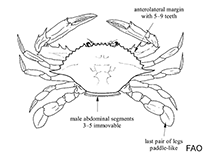
Carapace less than twice as broad as long; 9 stout teeth on strongly arched anterolateral margin, all except outer orbital tooth and short lateral spine usually swept forward; front bearing 4 well-developed teeth (excluding inner orbital angles). Coarse scattered and transverse lines of granules on convex dorsal surface. Pincers robust, ridges and crests coarsely granulate; fifth legs flattened form of paddles. Male with T-shaped abdomen reaching posterior quarter of thoracic sternite 4; first pleopods reaching slightly beyond suture between thoracic sternites 6 and 7, sinuously curved, overlapping proximally, diverging distally to tips curved abruptly inward, armed distally with scattered minute spinules. Color: adult male dorsally purplish red, more accented on proto-, meso-, and metagastric areas and at base of lateral spines and anterolateral teeth; branchial region and anterolateral teeth obscure maroon; dorsal surface of all legs purplish red with intense orange red on articulations; inferior portions of merus, carpus, and fingers of chelipeds intense violet; internal and external portion of chelae as well as remaining ventral aspect of animal white with tints of soft purple.
Maximum depth from Ref. 105697. Inhabits estuaries and shallow oceanic littoral zones, especially in association with mangroves and near river mouths, down to 8 m (Ref. 367). Possibly freshwater (Ref. 95880). Feeds on mollusks, other bottom invertebrates, fishes, carrion and detritus (Ref. 367). Digs the clam D. denticulatus out of the sand with one of its claws then handles and cracks its shell (Ref. 106085).
Vòng đời và hành vi giao phối
Chín muồi sinh dục | Sự tái sinh sản | Đẻ trứng | Các trứng | Sự sinh sản | Ấu trùng
Members of the order Decapoda are mostly gonochoric. Mating behavior: Precopulatory courtship ritual is common (through olfactory and tactile cues); usually indirect sperm transfer.
Tavares, M. 2003 True Crabs. pp. 327-352. In Carpenter, K.E. (ed.) The living marine resources of the Western Central Atlantic. Volume1: introdution, molluscs, crustaceans, hagfishes, sharks, batoid fishes, and chimaeras. FAO Species Identification Guide for Fishery Purposes and American Society of Ichthyologists and Herpetologists Special PublicationNo. 5. Rome, FAO. pp. 1-600. (Tài liệu tham khảo 367)
Tình trạng Sách đỏ IUCN
(Tài liệu tham khảo 130435: Version 2025-2 (Global))
tình trạng CITES (Tài liệu tham khảo 108899)
Not Evaluated
CMS (Tài liệu tham khảo 116361)
Not Evaluated
Mối đe dọa đối với con người
Sử dụng của con người
Các nghề cá: tính thương mại
FAO - Publication: search | FishSource |
Các công cụ
Thêm thông tin
Vòng đờiSự tái sinh sảnChín muồi sinh dụcSự sinh sảnĐẻ trứngCác trứngSự phát triển của trứngẤu trùng Sinh lý họcThành phần ô-xy
Liên quan đến con ngườiTem, tiền xu, v.v.
Các nguồn internet
Ước tính dựa trên mô hình
Sự dễ bị tổn thương của nghề đánh cá
(Tài liệu tham khảo 71543) |
Low vulnerability (10 of 100). |
Loại giá
(Tài liệu tham khảo 80766): |
Very high. |