Malacostraca |
Decapoda |
Portunidae
Umwelt: Milieu / Klimazone / Tiefenbereich / Verbreitungsgebiet
Ökologie
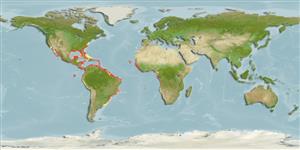
Benthopelagisch; tiefenbereich 0 - 110 m (Ref. 101598), usually ? - 20 m (Ref. 435). Tropical; 39°N - 36°S, 121°W - 14°E
Atlantic Ocean and Eastern Pacific: from USA (New Jersey to south Florida) to Brazil (Amapa to Rio Grande do Sul), including central America, the Antilles, and northern South America; West Africa from Mauritania to Angola, including Cape Verde, Sao Tome and Principe, and Annobon Islands; Eastern Pacific from California, and Baja California to Peru, including Clipperton Island and Galagapos Islands. Temperate to tropical.
Länge bei der ersten Reifung / Größe / Gewicht / Alter
Geschlechtsreife: Lm ? range ? - ? cm Max length : 5.2 cm CL Männchen/unbestimmt; (Ref. 435)
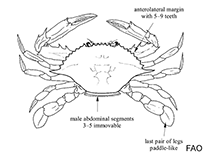
Carapace width range: 0.63 cm (Ref. 93549) to 8.2 cm (Ref. 435). Minimum depth from Ref. 104055. Benthopelagic (Ref. 97531). Occurs from the intertidal zone to a depth of 38 m, common at depths less than 20 m. Inhabits different kinds of bottom, usually covered with algae, ascidia, etc. (Ref 435). Found on sandy beaches, rocky areas as well as those with gravel (Ref. 104219). Also occurs in tide pools and rock rubble in sublittoral areas (Ref. 106321). In general, portunid crabs are reported to be mainly carnivorous (Ref. 72665).
Lebenszyklus und Paarungsverhalten
Geschlechtsreife | Fortpflanzung | Ablaichen | Eier | Fruchtbarkeit | Larven
Members of the order Decapoda are mostly gonochoric. Mating behavior: Precopulatory courtship ritual is common (through olfactory and tactile cues); usually indirect sperm transfer.
Fischer, W., G. Bianchi and W.B. Scott (eds.) 1981 True Crabs. 6: pag.var. In FAO species identification sheets for fishery purposes. Eastern Central Atlantic (fishing areas 34, 47; in part). Canada Funds-in-Trust. Ottawa, Department of Fisheries and Oceans Canada, by arrangement with the Food and AgriculturesOrganization of the United Nations, 1-7: pag.var. (Ref. 435)
IUCN Rote Liste Status
(Ref. 130435: Version 2025-2 (Global))
CITES Status (Ref. 108899)
Not Evaluated
Not Evaluated
Bedrohung für Menschen
Nutzung durch Menschen
FAO - Publication: search | FishSource |
Tools
Mehr Information
Trophische ÖkologieLebensmittel (Beutetiere)NahrungszusammensetzungNahrungsaufnahmeRäuber PopulationsdynamikWachstumMax. Alter/GrößenLänge-Gewicht-Rel.Länge-Länge-Verhältnis.LängenhäufigkeitenMassenkonvertierungDichte PhysiologieSauerstoffverbrauch
MenschenbezogenBriefmarken, Münzen, Verschiedenes.
Internet Quellen
Schätzungen auf der Grundlage von Modellen
Anfälligkeit der Fischerei
(Ref. 71543) |
Low vulnerability (10 of 100). |
Preiskategorie
(Ref. 80766): |
Unknown. |