Merostomata |
Xiphosura |
Limulidae
Milieu: milieu / Klimaatzone / Diepte / verspreidingsgebied
Ecologie
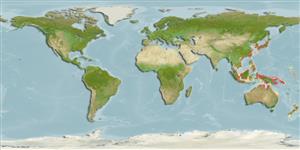
Benthic; brak water. Tropical
Western Pacific.
Lengte bij maturiteit / Grootte / Gewicht / Leeftijd
Maturiteit: Lm ? range ? - ? cm Max length : 92.0 cm TL mannelijk / geslacht onbekend; (Ref. 122452)
The horseshoe crab body is divided into three parts: the front dome-shaped prosoma, the middle marginally-spined opisthosoma, and the rear spike-like telson. The width of the prosoma is commonly in estimating the age and growth stages since it can be measured easily and yields the smalles errors in measurement (Ref. 127127).
Found in sandy and muddy shores (Refs. 127122, 65878). Occurs from low and high tide mark; often found at spring low tide (Ref. 1131) in mangrove swamps (Ref. 70). Breeds on sand patches at high tide (Ref. 68). Inhabits shallow intertidal pools dominated by Halophila beccarii. Juveniles burrow at low tide (Ref. 65787.
Levenscyclus en paargedrag
Maturiteit | Voortplanting | Paaien | Eieren | Fecunditeit | Larven
Chiu, H.M.C. and B. Morton 2004 The behavior of juvenile horseshoe crabs, Tachypleus tridentatus (Xiphosura), on a nursery beach at Shui Hau Wan, Hong Kong. Hydrobiologia 523:29-35. (Ref. 408)
Status op de Rode Lijst van het IUCN
(Ref. 130435: Version 2025-2 (Global))
CITES status (Ref. 108899)
Not Evaluated
Not Evaluated
Gevaar voor de mens
Poisonous to eat (Ref. 130560)
Gebruik door de mens
FAO - Publication: search | FIRMS (Stock assessments) | FishSource |
Tools
Meer informatie
LevenscyclusVoortplantingMaturiteitFecunditeitPaaienEierenOntwikkeling van de eierenLarven FysiologieZuurstofverbruik
Menselijk gerelateerdPostzegels, munten, diversen.
Internetbronnen
Schattingen op basis van modellen
Kwetsbaarheid van de visserij
(Ref. 71543) |
High vulnerability (57 of 100). |
Prijsklasse
(Ref. 80766): |
Unknown. |