Merostomata |
Xiphosura |
Limulidae
สิ่งแวดล้อม : สิ่งแวดล้อม / เขตภูมิอากาศ / ระดับความลึก / ระยะการกระจายสินค้า
นิเวศวิทยา
Benthic; กร่อย. Tropical
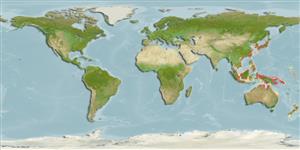
Western Pacific.
ความยาวเมื่อครบกำหนดครั้งแรก / ขนาด / น้ำหนัก / อายุ
วัยเจริญพันธุ์: Lm ? range ? - ? cm Max length : 92.0 cm TL เพศผู้/กระเทย; (อ้างอิง 122452)
The horseshoe crab body is divided into three parts: the front dome-shaped prosoma, the middle marginally-spined opisthosoma, and the rear spike-like telson. The width of the prosoma is commonly in estimating the age and growth stages since it can be measured easily and yields the smalles errors in measurement (Ref. 127127).
Found in sandy and muddy shores (Refs. 127122, 65878). Occurs from low and high tide mark; often found at spring low tide (Ref. 1131) in mangrove swamps (Ref. 70). Breeds on sand patches at high tide (Ref. 68). Inhabits shallow intertidal pools dominated by Halophila beccarii. Juveniles burrow at low tide (Ref. 65787.
วงจรชีวิตและพฤติกรรมการผสมพันธุ์
วัยเจริญพันธุ์ | การสืบพันธุ์ | การวางไข่ | เซลสืบพันธ์ของเพศเมีย(ไข่) | ความดกของไข่ | ตัวอ่อน
Chiu, H.M.C. and B. Morton 2004 The behavior of juvenile horseshoe crabs, Tachypleus tridentatus (Xiphosura), on a nursery beach at Shui Hau Wan, Hong Kong. Hydrobiologia 523:29-35. (อ้างอิง 408)
สถานะบัญชีแดงของ IUCN
(อ้างอิง 130435: Version 2025-2 (Global))
สถานะไซเตส (อ้างอิง 108899)
Not Evaluated
CMS (อ้างอิง 116361)
Not Evaluated
ภัยคุกคามต่อมนุษย์
Poisonous to eat (อ้างอิง 130560)
การใช้ของมนุษย์
FAO - Publication: search | FIRMS (Stock assessments) | FishSource |
เครื่องมือ
ข้อมูลเพิ่มเติม
วงจรชีวิตการสืบพันธุ์วัยเจริญพันธุ์ความดกของไข่การวางไข่เซลสืบพันธ์ของเพศเมีย(ไข่)การพัฒนาไข่ตัวอ่อน เกี่ยวข้องกับมนุษย์แสตมป์ เหรียญ อื่นๆ
แหล่งที่มาจากอินเตอร์เน็ต
การประมาณค่าตามแบบจำลอง
ความเสี่ยงต่อการตกปลา
(อ้างอิง 71543) |
High vulnerability (57 of 100). |
หมวดหมู่ราคา
(อ้างอิง 80766): |
Unknown. |