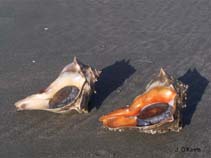
Gastropoda |
Neogastropoda |
Melongenidae
Milieu: milieu / Klimaatzone / Diepte / verspreidingsgebied
Ecologie
Benthic; diepte 0 - 75 m (Ref. 83435). Subtropical; 43°N - 18°N, 92°W - 66°W (Ref. 83435)
Western Atlantic Ocean: USA: From Cape Cod, Massachusetts to Cape Canaveral, Florida (Ref. 101477); Mexico: northern coast of Campeche (Ref. 101490).
Lengte bij maturiteit / Grootte / Gewicht / Leeftijd
Maturiteit: Lm 10.0 range ? - ? cm Max length : 24.9 cm DL mannelijk / geslacht onbekend; (Ref. 83435)
Maximum depth from Ref. 104440. Intertidal (Ref. 106829) to subtidal (Ref. 101477). Found in sand flats (Ref. 101477). Carnivorous. Forages on intertidal flats and creeks fringed by oyster reef and in subtidal channels (Ref. 106829). Preys on bivalves (Refs. 101524, 101525) such as oysters, scallops and clams (Ref. 106829). It uses the lip of its shell, synchronous with its foot, to penetrate, break off and force open the valves of its prey (Refs. 101524, 101525).
Levenscyclus en paargedrag
Maturiteit | Voortplanting | Paaien | Eieren | Fecunditeit | Larven
Broadcast spawners. Life cycle: Embryos emerged into miniature adults which further develop into grown adults (Ref. 833).
Bisby, F.A., M.A. Ruggiero, K.L. Wilson, M. Cachuela-Palacio, S.W. Kimani, Y.R. Roskov, A. Soulier-Perkins and J. van Hertum 2005 Species 2000 & ITIS Catalogue of Life: 2005 Annual Checklist. CD-ROM; Species 2000: Reading, U.K. (Ref. 19)
Status op de Rode Lijst van het IUCN
(Ref. 130435: Version 2025-2 (Global))
CITES status (Ref. 108899)
Not Evaluated
Not Evaluated
Gevaar voor de mens
Gebruik door de mens
Visserij: commercieel
FAO - Publication: search | FishSource |
Tools
Meer informatie
FysiologieZuurstofverbruik
Menselijk gerelateerdPostzegels, munten, diversen.
Internetbronnen
Schattingen op basis van modellen
Weerstandsvermogen
(Ref. 69278): |
Hoog, minimale populatieverdubbelingstijd minder dan 15 maanden (K=0.12-0.63; tm=5) |
Kwetsbaarheid van de visserij
(Ref. 71543) |
Low to moderate vulnerability (30 of 100). |
Prijsklasse
(Ref. 80766): |
Medium. |