Gastropoda |
Not assigned |
Lottiidae
Umwelt: Milieu / Klimazone / Tiefenbereich / Verbreitungsgebiet
Ökologie
Benthic. Subtropical
Eastern Central Pacific: USA to Mexico.
Länge bei der ersten Reifung / Größe / Gewicht / Alter
Geschlechtsreife: Lm ? range ? - ? cmCommon length : 10.0 cm SHL Männchen/unbestimmt; (Ref. 312)
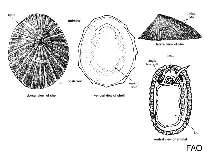
Light brown shell with whitish checks on the edge of the shell. The brown areas are slightly higher than the white spots. The peak of the shell is near the anterior margin. It has a brownish, bluish discoloration on the inside of the empty shell resembles the outline of an owl (Ref. 312).
It has a shell length of 10 cm (Ref. 312). Occurs on bare areas of rocks in the high to middle intertidal zones. Herbivorous, scrapes diatoms and algae off the rocky surface with their radula. Exhibits territorial behavior. Large animals are females and tend to 'farm' particular rock faces. If another limpet trespasses on this territory, female attacks by inserting its shell margin underneath the edge of the invader's shell and pries the invader off the rock. The smaller males are not territorial. When males reach a critical size they transform into females and begin farming (Ref. 312).
Lebenszyklus und Paarungsverhalten
Geschlechtsreife | Fortpflanzung | Ablaichen | Eier | Fruchtbarkeit | Larven
Members of the order Patellogastropoda are mostly gonochoric and broadcast spawners. Life cycle: Embryos develop into planktonic trocophore larvae and later into juvenile veligers before becoming fully grown adults.
Gallivan, G. and J. Danforth 1999 Phylum Mollusca. Marine Science Institute. (Ref. 312)
IUCN Rote Liste Status
(Ref. 130435: Version 2025-2 (Global))
CITES Status (Ref. 108899)
Not Evaluated
Not Evaluated
Bedrohung für Menschen
Nutzung durch Menschen
FAO - Publication: search | FishSource |
Tools
Mehr Information
PopulationsdynamikWachstum
Max. Alter/Größen
Länge-Gewicht-Rel.
Länge-Länge-Verhältnis.
Längenhäufigkeiten
Massenkonvertierung
Dichte
LebenszyklusFortpflanzungGeschlechtsreifeFruchtbarkeitAblaichenEierEientwicklungLarven PhysiologieSauerstoffverbrauch
MenschenbezogenBriefmarken, Münzen, Verschiedenes.
Internet Quellen
Schätzungen auf der Grundlage von Modellen
Anfälligkeit der Fischerei
(Ref. 71543) |
(0 of 100). |
Preiskategorie
(Ref. 80766): |
Unknown. |