Gastropoda |
Not assigned |
Lottiidae
Entorno: milieu / zona climática / rango de profundidad / gama de distribución
Ecología
Benthic. Subtropical
Distribución
Territories | Áreas FAO | Ecosistemas | Ocurrencias, apariciones | Introducciones
Eastern Central Pacific: USA to Mexico.
Longitud en la primera madurez / Tamaño / Peso / Edad
Madurez: Lm ? range ? - ? cmCommon length : 10.0 cm SHL macho / no sexado; (Referencia 312)
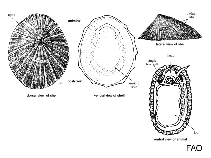
Light brown shell with whitish checks on the edge of the shell. The brown areas are slightly higher than the white spots. The peak of the shell is near the anterior margin. It has a brownish, bluish discoloration on the inside of the empty shell resembles the outline of an owl (Ref. 312).
It has a shell length of 10 cm (Ref. 312). Occurs on bare areas of rocks in the high to middle intertidal zones. Herbivorous, scrapes diatoms and algae off the rocky surface with their radula. Exhibits territorial behavior. Large animals are females and tend to 'farm' particular rock faces. If another limpet trespasses on this territory, female attacks by inserting its shell margin underneath the edge of the invader's shell and pries the invader off the rock. The smaller males are not territorial. When males reach a critical size they transform into females and begin farming (Ref. 312).
Ciclo vital y comportamiento de apareamiento
Madurez | Reproducción | Puesta | Huevos | Fecundidad | Larva
Members of the order Patellogastropoda are mostly gonochoric and broadcast spawners. Life cycle: Embryos develop into planktonic trocophore larvae and later into juvenile veligers before becoming fully grown adults.
Gallivan, G. and J. Danforth 1999 Phylum Mollusca. Marine Science Institute. (Referencia 312)
Situación en la Lista Roja de la UICN
(Referencia 130435: Version 2025-2 (Global))
Estatus CITES (Referencia 108899)
Not Evaluated
CMS (Referencia 116361)
Not Evaluated
Amenaza para el ser humano
Usos humanos
FAO - Publication: search | FishSource |
Herramientas
Más información
Dinámica de la poblaciónCrecimiento
Edades / tallas máximas
Longitud-peso rel.
Longitud-longitud rel.
Longitud-frecuencias
Conversión de masas
Abundancia
Ciclo de vidaReproducciónMadurezFecundidadPuestaHuevosDesarrollo de los huevosLarva FisiologíaConsumo del oxígeno
Relacionados con el ser humanoSellos, monedas, varios
Fuentes de Internet
Estimaciones basadas en modelos
Vulnerabilidad pesquera
(Referencia 71543) |
(0 of 100). |
Categoría de precios
(Referencia 80766): |
Unknown. |