Octocorallia |
Malacalcyonacea |
Tubiporidae
Umwelt: Milieu / Klimazone / Tiefenbereich / Verbreitungsgebiet
Ökologie
Riff-verbunden; tiefenbereich 3 - 15 m (Ref. 8294). Tropical; 27°C - 28°C (Ref. 130889)
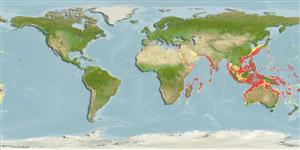
Indo-West Pacific: West to Red Sea; north to Japan, east to Vanuatu; south to Australia.
Länge bei der ersten Reifung / Größe / Gewicht / Alter
Geschlechtsreife: Lm ? range ? - ? cm Max length : 50.0 cm COLD Männchen/unbestimmt; (Ref. 269)
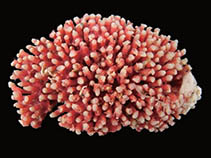
Colonies form mounds up to 50 cm in diameter that may dominate large patches of reef. The colonies are composed of thin tubes (the "organ pipes"), 0.2 cm diameter in length, cemented together by horizontal plates at intervals of several centimeters. In life, the corals have white polyps that may cover the corallum. The skeleton is deep red (Ref. 269).
Maximum depth from Ref. 123855. Abundant in mid-shelf reefs, becomes prolific at a depth of 20 m. Less common in muddy coastal areas (Ref. 101098). Common from the reef flat to intermediate depths (Ref. 296).
Lebenszyklus und Paarungsverhalten
Geschlechtsreife | Fortpflanzung | Ablaichen | Eier | Fruchtbarkeit | Larven
Members of the class Anthozoa are either gonochoric or hermaphroditic. Mature gametes are shed into the coelenteron and spawned through the mouth. Life cycle: The zygote develops into a planktonic planula larva. Metamorphosis begins with early morphogenesis of tentacles, septa and pharynx before larval settlement on the aboral end.
Ross, M.A. and G. Hodgson 1981 A quantitative study of hermatypic coral diversity and zonation at Apo Reef, Mindiro, Philippines. Proceedings of the Fourth International Coral Reef Syposium, Manila 2:281-291. (Ref. 8294)
IUCN Rote Liste Status
(Ref. 130435: Version 2025-2 (Global))
CITES Status (Ref. 108899)
Not Evaluated
Bedrohung für Menschen
Nutzung durch Menschen
Fischereien: kommerzielles potential
FAO - Publication: search | FishSource | Das Meer um uns herum
Tools
Mehr Information
Trophische ÖkologieLebensmittel (Beutetiere)
Nahrungszusammensetzung
Nahrungsaufnahme
Räuber
PopulationsdynamikWachstumMax. Alter/GrößenLänge-Gewicht-Rel.Länge-Länge-Verhältnis.LängenhäufigkeitenMassenkonvertierungDichte LebenszyklusFortpflanzungGeschlechtsreifeFruchtbarkeitAblaichenEierEientwicklungLarven PhysiologieSauerstoffverbrauch
MenschenbezogenBriefmarken, Münzen, Verschiedenes.
Internet Quellen
Schätzungen auf der Grundlage von Modellen
Anfälligkeit der Fischerei
(Ref. 71543) |
Moderate vulnerability (40 of 100). |
Preiskategorie
(Ref. 80766): |
Unknown. |