Scyphozoa |
Rhizostomeae |
Rhizostomatidae
Miljö: miljö / Klimatzon / djupintervall / distributionsområde
Ekologi
Pelagiska; djupintervall 0 - 40 m (Ref. 122800). Subtropical; 46°N - 30°N, 5°W - 42°E (Ref. 121705)
Mediterranean and Black Sea: from Alboran Sea to Libya in the Mediterranean, east to Russia and north to Ukraine, Black Sea.
Längd vid första mognad / Storlek / Vikt / Ålder
Könsmognad: Lm ?, range 12 - 15 cm Max length : 90.0 cm WD hane/ej könsbestämd; (Ref. 358); common length : 60.0 cm WD hane/ej könsbestämd; (Ref. 358)
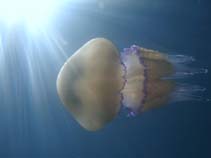
Diameter of about 60 cm, exceptionally 90 cm. The sunshade is very bent, sometimes even higher than broad; the periphery is deprived of tentacles, replaced by approximately 80-90 lobes distributed on the entire circumference. One counts 8 very long oral; only braided arms towards their base; and comprising with milonguor of the appendices dermic in the cauliflower shape, while the ends smooth and are not ramified. Color: blue; yellow or pink milky; blue lobes ombrellaires with purple darker.
Largest in the Mediterranean, is rather not very irritant: the cnidocytes are slightly poisonous and do not transpierce the human skin; there is thus no risk of lesion. Euryhaline species (Ref. 122857). Found in a river estuary (Ref. 122860) and coastal lagoons (Refs. 81044, 122857). Abundant inshore but also found offshore (Ref. 122861).
Livscykel och parningsbeteende
Könsmognad | Reproduktion | Lek | Ägg | Fekunditet | Larver
Members of the class Scyphozoa are gonochoric. Life cycle: Egg is laid by the adult medusa which later develops into a free-living planula, then to a scyphistoma to a strobila, and lastly to a free-living young medusa.
Göthel, H. 1992 Guide de la faune sous-marine: La Méditerranée. Invertébrés marins et poissons. Eygen Ulmer GmbH & Co. 318 p. (Ref. 358)
Status på IUCN:s rödlista
(Ref. 130435: Version 2025-2 (Global))
CITES-status (Ref. 108899)
Not Evaluated
Not Evaluated
Hot mot människor
Mänskliga användningsområden
Fiskeri: kommersiell
FAO - Publication: search | FishSource |
Verktyg
Ytterligare information
MänniskorelateradFrimärken, mynt, diverse.
Internet-källor
Uppskattningar baserade på modeller
Resiliens
(Ref. 69278): |
Hög, lägsta populationsfördubblingstid mindre än 15 månader (K=3.76) |
Sårbarhet i fisket
(Ref. 71543) |
Low to moderate vulnerability (28 of 100). |
Priskategori
(Ref. 80766): |
Unknown. |