Scyphozoa |
Rhizostomeae |
Stomolophidae
Umwelt: Milieu / Klimazone / Tiefenbereich / Verbreitungsgebiet
Ökologie
Pelagisch; brackwasser; tiefenbereich 0 - 85 m (Ref. 116114). Tropical; 42°N - 30°S, 118°W - 34°W
Western Atlantic and Eastern Pacific: Tropical to temperate.
Länge bei der ersten Reifung / Größe / Gewicht / Alter
Geschlechtsreife: Lm 10.5 range ? - ? cm Max length : 18.0 cm WD Männchen/unbestimmt; (Ref. 2992)
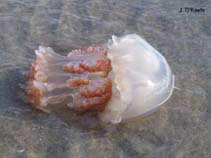
Up to 18 cm wide, half egg shaped or almost globular; number of velar lappets variable, about 14 in each octant, grooves between them short, all alike; scapules large, extending to or beyond level of bell margin; the free, bifurcate ends of the mouth-arms flare outwards, the lateral branches long.
Neritic, estuarine, potentially pathogenic (Ref. 116114). Feeds on bivalve veligers, gastropod veligers, copepod eggs, nauplii, copepodites and adults, and Oikopleura sp. (Ref. 106824).
Lebenszyklus und Paarungsverhalten
Geschlechtsreife | Fortpflanzung | Ablaichen | Eier | Fruchtbarkeit | Larven
The fertilized egg develops into a tiny, motile planula larva. After swimming freely in the water for several days, the planula attaches to a suitable substrate and transforms into a sessile polyp or scyphistoma. Scyphistomae feed and grow, attaining a maximum size of a few mm. They reproduce asexually a number of ways, including the formation of podocysts and motile or non-motile buds, but only podocyst. The scyphistoma undergoes strobilation which results to ephyrae; developing itself into medusae.
Migotto, A.E., A.C. Marques, A.C. Morandini and F.L. da Silveira 2002 Checklist of the cnidaria medusozoa of Brazil. Biota Neotropica 2(1):1-31. (Ref. 813)
IUCN Rote Liste Status
(Ref. 130435: Version 2025-2 (Global))
CITES Status (Ref. 108899)
Not Evaluated
Not Evaluated
Bedrohung für Menschen
Nutzung durch Menschen
Fischereien: kommerziell
FAO - Publication: search | FishSource |
Tools
Mehr Information
PhysiologieSauerstoffverbrauch
MenschenbezogenBriefmarken, Münzen, Verschiedenes.
Internet Quellen
Schätzungen auf der Grundlage von Modellen
Anfälligkeit der Fischerei
(Ref. 71543) |
Low vulnerability (10 of 100). |
Preiskategorie
(Ref. 80766): |
Unknown. |