Scyphozoa |
Rhizostomeae |
Stomolophidae
สิ่งแวดล้อม : สิ่งแวดล้อม / เขตภูมิอากาศ / ระดับความลึก / ระยะการกระจายสินค้า
นิเวศวิทยา
ผิวน้ำ; กร่อย; ระดับความลึก 0 - 85 m (อ้างอิง 116114). Tropical; 42°N - 30°S, 118°W - 34°W
Western Atlantic and Eastern Pacific: Tropical to temperate.
ความยาวเมื่อครบกำหนดครั้งแรก / ขนาด / น้ำหนัก / อายุ
วัยเจริญพันธุ์: Lm 10.5 range ? - ? cm Max length : 18.0 cm WD เพศผู้/กระเทย; (อ้างอิง 2992)
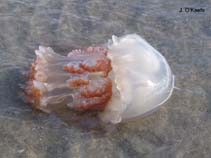
Up to 18 cm wide, half egg shaped or almost globular; number of velar lappets variable, about 14 in each octant, grooves between them short, all alike; scapules large, extending to or beyond level of bell margin; the free, bifurcate ends of the mouth-arms flare outwards, the lateral branches long.
Neritic, estuarine, potentially pathogenic (Ref. 116114). Feeds on bivalve veligers, gastropod veligers, copepod eggs, nauplii, copepodites and adults, and Oikopleura sp. (Ref. 106824).
วงจรชีวิตและพฤติกรรมการผสมพันธุ์
วัยเจริญพันธุ์ | การสืบพันธุ์ | การวางไข่ | เซลสืบพันธ์ของเพศเมีย(ไข่) | ความดกของไข่ | ตัวอ่อน
The fertilized egg develops into a tiny, motile planula larva. After swimming freely in the water for several days, the planula attaches to a suitable substrate and transforms into a sessile polyp or scyphistoma. Scyphistomae feed and grow, attaining a maximum size of a few mm. They reproduce asexually a number of ways, including the formation of podocysts and motile or non-motile buds, but only podocyst. The scyphistoma undergoes strobilation which results to ephyrae; developing itself into medusae.
Migotto, A.E., A.C. Marques, A.C. Morandini and F.L. da Silveira 2002 Checklist of the cnidaria medusozoa of Brazil. Biota Neotropica 2(1):1-31. (อ้างอิง 813)
สถานะบัญชีแดงของ IUCN
(อ้างอิง 130435: Version 2025-2 (Global))
สถานะไซเตส (อ้างอิง 108899)
Not Evaluated
CMS (อ้างอิง 116361)
Not Evaluated
ภัยคุกคามต่อมนุษย์
การใช้ของมนุษย์
การประมง: การค้า
FAO - Publication: search | FishSource |
เครื่องมือ
ข้อมูลเพิ่มเติม
เกี่ยวข้องกับมนุษย์แสตมป์ เหรียญ อื่นๆ
แหล่งที่มาจากอินเตอร์เน็ต
การประมาณค่าตามแบบจำลอง
ความเสี่ยงต่อการตกปลา
(อ้างอิง 71543) |
Low vulnerability (10 of 100). |
หมวดหมู่ราคา
(อ้างอิง 80766): |
Unknown. |