Scyphozoa |
Semaeostomeae |
Ulmaridae | Aureliinae
Umwelt: Milieu / Klimazone / Tiefenbereich / Verbreitungsgebiet
Ökologie
Pelagisch; brackwasser; tiefenbereich 0 - 1250 m (Ref. 116114). Subtropical; 78°N - 55°S, 180°W - 180°E
Circumglobal. This species is widespread in all the seas of the sphere, from the equator to the poles. Subtropical to polar.
Länge bei der ersten Reifung / Größe / Gewicht / Alter
Geschlechtsreife: Lm ?, range 2 - 31 cm Max length : 50.0 cm WD Männchen/unbestimmt; (Ref. 2376)
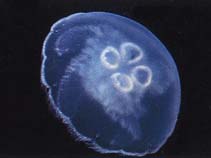
Maximum diameter: 50 cm (Ref. 358); Height, from 10 to 12.5 cm; diameter, being able to reach 40 to 50 cm (Ref. 363). Plane sunshade; comprising very many tentacles courts with the periphery. One counts 4 oral arms; and 4 sexual organs; of annular form or in the horseshoe shape very many radiate channels. Coloring: generally translucent, with slightly pink reflections, blue or purple; the sexual organs are more clearly colored red or pink (Ref. 358).
This species is being eaten by predators because of its high fatty acid content (Ref. 122155). Neritic, potentially pathogenic (Ref. 116114). Free living near the water's surface in pelagic zones (Ref. 2997), close to coasts (Ref. 358), and offshore (Ref. 813); also found in brackish waters (Ref. 2993), coastal embayments, fjords and estuaries (Ref. 3289). Their cnidocytes cannot transpierce the human skin. Suspension feeder (Ref. 3269) on tintinnids, rotifers, cladocerans and larvae of copepods (harpacticoid), barnacles (nauplii; Ref. 3053) and on fish larvae (Ref. 7715). Several cases reported sea anemones to feed on this species; fungiid coral is also an occasional feeder. Provides vital fatty acids for fishes and crustacean predators. Nutritional value of this species from macronutrients and key fatty acids appears to be important over only meeting a predator's energy demands (Ref. 122155).
High abundances of ephyrae during late autumn can be explained by the large number of poly disc scyphistomae preceding to the appearance of ephyrae (Ref. 3062). Polyps begin to develop in August-September, matures in October and dies in November (Ref. 3271). Budding doesn’t occur in winter months (Ref. 7721). Can live up to 2 years (Ref. 3049).
Wrobel, D. and C.E. Mills 1998 Pacific coasts pelagic invertebrates: a guide to the common gelatinous animals. Sea Challengers and the Monterey Bay Aquarium, Monterey, California.112 p. (Ref. 2376)
IUCN Rote Liste Status
(Ref. 130435: Version 2025-2 (Global))
CITES Status (Ref. 108899)
Not Evaluated
Not Evaluated
Bedrohung für Menschen
Nutzung durch Menschen
Fischereien: kommerziell
FAO - Publication: search | FishSource |
Tools
Mehr Information
PhysiologieSauerstoffverbrauch
MenschenbezogenBriefmarken, Münzen, Verschiedenes.
Internet Quellen
Schätzungen auf der Grundlage von Modellen
Widerstandsfähigkeit
(Ref. 69278): |
hoch, Verdopplung der Population dauert weniger als 15 Monate. (K=0.45-3.83) |
Anfälligkeit der Fischerei
(Ref. 71543) |
Low vulnerability (25 of 100). |
Preiskategorie
(Ref. 80766): |
Unknown. |