Scyphozoa |
Rhizostomeae |
Cepheidae
Miljö: miljö / Klimatzon / djupintervall / distributionsområde
Ekologi
Pelagiska; djupintervall 0 - 7 m (Ref. 3254). Subtropical
Mediterranean Sea: Italy, Greece and Monaco.
Längd vid första mognad / Storlek / Vikt / Ålder
Könsmognad: Lm ? range ? - ? cm Max length : 40.0 cm WD hane/ej könsbestämd; (Ref. 358)
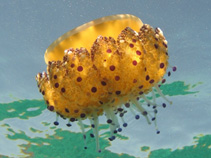
Diameter can reach 40 cm. Plane sunshade, except in its center, where one observes a prominent formation out of bell. Short oral arms, only braided in their base, characterized by a lower part excessively friz; the labial palpi are of color violet or white, and finished by a widened bulb. The sunshade is white, the oral arms of a tinted white of yellow. The polyps measure from 5 to 10 mm height; and although unimportant, one can observe them all the year.
The sunshade of the céphéides is frequently used as protective shelter with fish alevins of the kinds Trachurus ,Boops and Seriola. Species is inoffensive for the man (Ref. 358). Swims to the surface in plain water, in pelagic zone, near the coasts at night. Feeds on fine plankton, which is absorbed by the oral arms (Ref. 358).
Livscykel och parningsbeteende
Könsmognad | Reproduktion | Lek | Ägg | Fekunditet | Larver
The polyps start to bud at the beginning of spring. These larvae evolve/move in jellyfishes, which one meets only from July to November, frequently associated gigantic swarms, length of several kilometers. When a storm prevails, the jellyfishes gagnet bottom. But one also observes this type of migration of surface towards deep water independently of any climatic factor. The males become ripe are recognizable with the presence, in some their palpi, spermatic channels filled up of gametes and colored in white, which will be released in the marine environment. Fecundation takes place inside the body of the females. Before their emission in the sea, the larvae remain a few times inside specialized oral arms, responsible for incubation. Then they will evolve/move in sedentary polyp (Ref. 358).
Göthel, H. 1992 Guide de la faune sous-marine: La Méditerranée. Invertébrés marins et poissons. Eygen Ulmer GmbH & Co. 318 p. (Ref. 358)
Status på IUCN:s rödlista
(Ref. 130435: Version 2025-2 (Global))
CITES-status (Ref. 108899)
Not Evaluated
Not Evaluated
Hot mot människor
Mänskliga användningsområden
FAO - Publication: search | FishSource |
Verktyg
Ytterligare information
LivscykelReproduktionKönsmognadFekunditetLekÄggUtveckling av äggLarver MänniskorelateradFrimärken, mynt, diverse.
Internet-källor
Uppskattningar baserade på modeller
Resiliens
(Ref. 69278): |
Hög, lägsta populationsfördubblingstid mindre än 15 månader (K=0.73-2.1) |
Sårbarhet i fisket
(Ref. 71543) |
Low vulnerability (21 of 100). |
Priskategori
(Ref. 80766): |
Unknown. |