Scyphozoa |
Rhizostomeae |
Mastigiidae
Milieu: milieu / Klimaatzone / Diepte / verspreidingsgebied
Ecologie
Pelagisch. Tropical; 47°N - 34°S, 28°E - 178°W
Indo-West Pacific: from South Africa north to Russia and east to Fiji. Tropical to temperate.
Lengte bij maturiteit / Grootte / Gewicht / Leeftijd
Maturiteit: Lm ? range ? - ? cm Max length : 8.0 cm WD mannelijk / geslacht onbekend; (Ref. 121705)
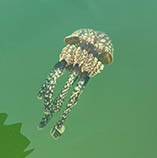
Up to 8 cm wide, usually hemispherical, exumbrella with very fine granulations; gelationous substance firm; deep furrows between the 8 velar lappets (in each octant); mouth-arms about half as long as bell diameter, the simple upper portion one and a half times as long as the three-winged lower portion; each arm usually, but not always, terminates in a club-like filament, triangularin cross-section; numerous small, club-shaped cesicles between mouths; less than 10 canal-roots in each octant; rhopalar canals clender, usually with anastomoses.
Mostly in shallow waters during the day to allow its symbiotic zooxanthellae (where it derives its energy from) to bathe in sunlight. Mainly solitary. As the sun mainly influences its habits, it descends to lower parts of the water column when the sun sets. It gathers food such as zooplankton, phytoplankton, small invertebrates, and microbes using the oral arms of its mouth (Ref. 101744).
Levenscyclus en paargedrag
Maturiteit | Voortplanting | Paaien | Eieren | Fecunditeit | Larven
Members of the class Scyphozoa are gonochoric. Life cycle: Egg is laid by the adult medusa which later develops into a free-living planula, then to a scyphistoma to a strobila, and lastly to a free-living young medusa.
Kramp, P.L. 1961 Synopsis of the medusae of the world. J Mar Biol Ass UK 40:1-469. (Ref. 2992)
Status op de Rode Lijst van het IUCN
(Ref. 130435: Version 2025-2 (Global))
CITES status (Ref. 108899)
Not Evaluated
Not Evaluated
Gevaar voor de mens
Gebruik door de mens
FAO - Publication: search | FishSource |
Tools
Meer informatie
PopulatiedynamicaGroei
Max. leeftijden / maten
Lengte-gewicht rel.
Lengte-lengte rel.
Lengtefrequenties
Massaconversie
Abundantie
LevenscyclusVoortplantingMaturiteitFecunditeitPaaienEierenOntwikkeling van de eierenLarven FysiologieZuurstofverbruik
Menselijk gerelateerdPostzegels, munten, diversen.
Internetbronnen
Schattingen op basis van modellen
Kwetsbaarheid van de visserij
(Ref. 71543) |
Low vulnerability (10 of 100). |
Prijsklasse
(Ref. 80766): |
Unknown. |