Hexacorallia |
Scleractinia |
Oculinidae
Environnement : milieu / zone climatique / profondeur / gamme de distribution
Écologie
Récifal; profondeur 3 - 25 m (Réf. 8294). Tropical; 36°N - 31°S, 32°E - 137°W (Réf. 847)
Indo-Pacific: Japan to Australia and Egypt to Tahiti.
Longueur à la première maturité / Taille / Poids / Âge
Maturité: Lm ? range ? - ? cm Max length : 500 cm COLD mâle / non sexé; (Réf. 847)
Description synthétique
Morphologie
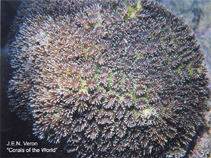
small colonies are cushion-shaped or low domes or are irregular. Colonies are large and usually exceed 5 meters across. Corallites are of mixed sizes and are usually less than 10 mm in diameter. Tentacles are extended during the day and may be green, grey, red or brown with tentacles and septa of contrasting colors.
Depth based from occurrence (Ref. 8294); to be replaced with a better reference.
Cycle de vie et comportement reproducteur
Maturité | Reproduction | Frai | Œufs | Fécondité | Larves
Hermaphroditic (Refs. 113708, 113712). Mature gametes are shed into the coelenteron and spawned through the mouth. Life cycle: The zygote develops into a planktonic planula larva. Metamorphosis begins with early morphogenesis of tentacles, septa and pharynx before larval settlement on the aboral end (Ref. 833).
Babcock, R.C. 2003 Identification of Sclerectinian Coral Recruits from Indo-Pacific Reefs. Zoological Studies 42 (1):211-226. (Réf. 791)
Statut dans la liste rouge de l'IUCN
(Réf. 130435: Version 2025-2 (Global))
statut CITES (Réf. 108899)
Not Evaluated
Menace pour l'homme
Utilisations par l'homme
FAO - Publication: search | FishSource |
Outils
Plus d'informations
Écologie trophiqueAliments (proies)
Composition du régime alimentaire
Consommation alimentaire
Prédateurs
Dynamique des populations PhysiologieConsommation d'oxygène
Liées à l'hommeTimbres, pièces de monnaie, divers
Sources Internet
Estimations basées sur des modèles
Vulnérabilité de la pêche
(Réf. 71543) |
Very high vulnerability (90 of 100). |
Catégorie de prix
(Réf. 80766): |
Unknown. |