Hexacorallia |
Scleractinia |
Oculinidae
Miljö: miljö / Klimatzon / djupintervall / distributionsområde
Ekologi
Revassocierade; djupintervall 3 - 25 m (Ref. 8294). Tropical; 36°N - 31°S, 32°E - 137°W (Ref. 847)
Indo-Pacific: Japan to Australia and Egypt to Tahiti.
Längd vid första mognad / Storlek / Vikt / Ålder
Könsmognad: Lm ? range ? - ? cm Max length : 500 cm COLD hane/ej könsbestämd; (Ref. 847)
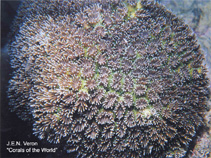
small colonies are cushion-shaped or low domes or are irregular. Colonies are large and usually exceed 5 meters across. Corallites are of mixed sizes and are usually less than 10 mm in diameter. Tentacles are extended during the day and may be green, grey, red or brown with tentacles and septa of contrasting colors.
Depth based from occurrence (Ref. 8294); to be replaced with a better reference.
Livscykel och parningsbeteende
Könsmognad | Reproduktion | Lek | Ägg | Fekunditet | Larver
Hermaphroditic (Refs. 113708, 113712). Mature gametes are shed into the coelenteron and spawned through the mouth. Life cycle: The zygote develops into a planktonic planula larva. Metamorphosis begins with early morphogenesis of tentacles, septa and pharynx before larval settlement on the aboral end (Ref. 833).
Babcock, R.C. 2003 Identification of Sclerectinian Coral Recruits from Indo-Pacific Reefs. Zoological Studies 42 (1):211-226. (Ref. 791)
Status på IUCN:s rödlista
(Ref. 130435: Version 2025-2 (Global))
CITES-status (Ref. 108899)
Not Evaluated
Hot mot människor
Mänskliga användningsområden
FAO - Publication: search | FishSource |
Verktyg
Ytterligare information
Trofisk ekologiLivsmedelsartiklar (preys)
Födosammansättning
Födointag
Predatorer
MänniskorelateradFrimärken, mynt, diverse.
Internet-källor
Uppskattningar baserade på modeller
Sårbarhet i fisket
(Ref. 71543) |
Very high vulnerability (90 of 100). |
Priskategori
(Ref. 80766): |
Unknown. |