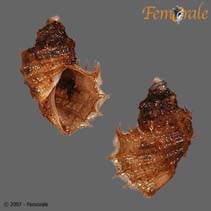
Gastropoda |
Littorinimorpha |
Capulidae
Environnement : milieu / zone climatique / profondeur / gamme de distribution
Écologie
Benthic; profondeur 2 - 944 m (Réf. 83435). Polar; 82°N - 42°N, 140°E - 0°E (Réf. 83435)
Arctic, Northern Pacific and Northern Atlantic.
Longueur à la première maturité / Taille / Poids / Âge
Maturité: Lm ? range ? - ? cm Max length : 2.2 cm DL mâle / non sexé; (Réf. 83435)
Maximum depth from Ref. 116516.
Cycle de vie et comportement reproducteur
Maturité | Reproduction | Frai | Œufs | Fécondité | Larves
Members of the order Neotaenioglossa are mostly gonochoric and broadcast spawners. Life cycle: Embryos develop into planktonic trocophore larvae and later into juvenile veligers before becoming fully grown adults.
Glagolev, S.M., L.A. Abramova and A.A. Vedenin 2006 The list of invertebrate animal species of the Chupa Bay (Kandalaksha Gulf, White Sea). The materials of the White Sea Expedition of Moscow Southwest High School Vol. 6. http://herba,su.ru/shipunov/belomor/english/2006/bespy-e.htm [Accessed 23/04/2007] (Réf. 3527)
Statut dans la liste rouge de l'IUCN
(Réf. 130435: Version 2025-2 (Global))
statut CITES (Réf. 108899)
Not Evaluated
Not Evaluated
Menace pour l'homme
Utilisations par l'homme
FAO - Publication: search | FishSource |
Outils
Plus d'informations
Écologie trophiqueAliments (proies)
Composition du régime alimentaire
Consommation alimentaire
Prédateurs
Dynamique des populationsCroissance
Âges / tailles maximales
Longueur-poids rel.
Rel. longueur-longueur.
Fréquences de longueurs
Conversion de masse
Abondance
Cycle de vieReproductionMaturitéFéconditéFraiŒufsDéveloppement de l'œufLarves PhysiologieConsommation d'oxygène
Liées à l'hommeTimbres, pièces de monnaie, divers
Sources Internet
Estimations basées sur des modèles
Vulnérabilité de la pêche
(Réf. 71543) |
Low vulnerability (10 of 100). |
Catégorie de prix
(Réf. 80766): |
Unknown. |