Bivalvia |
Pectinida |
Pectinidae
Miljö: miljö / Klimatzon / djupintervall / distributionsområde
Ekologi
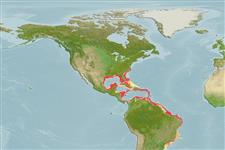
Benthic; djupintervall 1 - 151 m (Ref. 101602). Tropical; 37°N - 30°S, 91°W - 34°W
Western Atlantic: from North Carolina, USA and Bermuda, to Yucatan, Mexico south to Santa Catarina State, Brazil.
Längd vid första mognad / Storlek / Vikt / Ålder
Könsmognad: Lm ? range ? - ? cm Max length : 11.0 cm SHL hane/ej könsbestämd; (Ref. 344); common length : 11.0 cm SHL hane/ej könsbestämd; (Ref. 344)
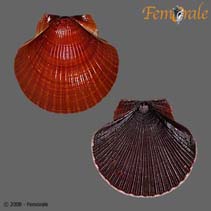
Shell circular, inequivalve, lower valve strongly concave, upper valve flatter, slightly convex. Hinge with wing-like projections of equal size. Sculpture on upper (flat) valve of about 35 ribs and interspaces of about same width. Lower (deep) valve with about 20 less prominent ribs. Colour: tan to light brown. Inner surface of lower valve white. Upper valve mottled with reddish brown and dark brown markings.
Subtidal species, partly buried in sand (Ref. 344) wherein they filter the interface between the seabed and the water column for food, mainly diatoms (Ref. 104076). Capable of limited rotational movement which allows resuspension of sediments, thus increasing food availability in its surroundings (Ref. 104076). Individuals form aggregations (Ref. 344). Also Refs. 8319, 112947.
Livscykel och parningsbeteende
Könsmognad | Reproduktion | Lek | Ägg | Fekunditet | Larver
Members of the class Bivalvia are mostly gonochoric, some are protandric hermaphrodites (Ref. 833). Species is a hermaphrodite exhibiting asynchronous reproduction. Spawning occurs during summer, autumn and spring. Protandric individuals dominate during spring time while proterogynous individuals dominate in summer and autumn (Ref. 93548). Life cycle: Embryos develop into free-swimming trocophore larvae, succeeded by the bivalve veliger, resembling a miniature clam (Ref. 833).
Leal, J.H. 2003 Bivalves. p. 25-98. In Carpenter, K.E. (ed.). The living marine resources of the Western Central Atlantic. Volume 1: Introduction, molluscs, crustaceans, hagfishes, sharks, batoid fishes, and chimaeras. FAO Species Identification Guide for Fishery Purposes and American Society of Ichthyologists and Herpetologists Special Publication No. 5. 1600p. (Ref. 344)
Status på IUCN:s rödlista
(Ref. 130435: Version 2025-2 (Global))
CITES-status (Ref. 108899)
Not Evaluated
Not Evaluated
Hot mot människor
Mänskliga användningsområden
Fiskeri: kommersiell
FAO - Publication: search | FishSource |
Verktyg
Ytterligare information
LivscykelReproduktionKönsmognadFekunditetLekÄggUtveckling av äggLarver MänniskorelateradFrimärken, mynt, diverse.
Internet-källor
Uppskattningar baserade på modeller
Sårbarhet i fisket
(Ref. 71543) |
Low vulnerability (10 of 100). |
Priskategori
(Ref. 80766): |
Medium. |