Bivalvia |
Arcida |
Arcidae
Miljö: miljö / Klimatzon / djupintervall / distributionsområde
Ekologi
Benthic; djupintervall 0 - 140 m (Ref. 83435). Tropical; 70°N - 34°S, 98°W - 2°E
Atlantic Ocean.
Längd vid första mognad / Storlek / Vikt / Ålder
Könsmognad: Lm ? range ? - 5 cm Max length : 10.0 cm SHL hane/ej könsbestämd; (Ref. 344)
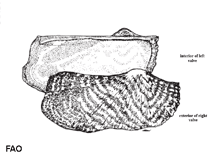
Diagnostic features: Shell rectangular, elongate (twice as long as wide), equivalve. Sculpture of about 20 to 30 irregular radial ribs, and fine concentric threads that cross-ribs and interspaces. Byssal gap present opposite to hinge, moderately narrow. Hinge long. Colour: creamy white, streaked with reddish to dark brown wavy bands. Periostracum brown and dense on fresh shells, covering colour pattern almost completely (Ref. 344).
Maximum size reported in Malacolog database was 9 cm in length (Ref. 83435). Epibiotic (Ref. 104365). It is found attached to the underside of rocks and coral heads by byssus (Ref. 344). Commonly forms dense beds on rocky bottoms at depths of 1 and 20 m (Ref. 121800)
Life cycle: Embryos develop into free-swimming trocophore larvae, succeeded by the bivalve veliger, resembling a miniature clam (Ref. 833).
Leal, J.H. 2003 Bivalves. p. 25-98. In Carpenter, K.E. (ed.). The living marine resources of the Western Central Atlantic. Volume 1: Introduction, molluscs, crustaceans, hagfishes, sharks, batoid fishes, and chimaeras. FAO Species Identification Guide for Fishery Purposes and American Society of Ichthyologists and Herpetologists Special Publication No. 5. 1600p. (Ref. 344)
Status på IUCN:s rödlista
(Ref. 130435: Version 2025-2 (Global))
CITES-status (Ref. 108899)
Not Evaluated
Not Evaluated
Hot mot människor
Mänskliga användningsområden
Fiskeri: kommersiell
FAO - Publication: search | FishSource |
Verktyg
Ytterligare information
Trofisk ekologiLivsmedelsartiklar (preys)FödosammansättningFödointagPredatorer MänniskorelateradFrimärken, mynt, diverse.
Internet-källor
Uppskattningar baserade på modeller
Resiliens
(Ref. 69278): |
Hög, lägsta populationsfördubblingstid mindre än 15 månader (K=1.2) |
Sårbarhet i fisket
(Ref. 71543) |
Low vulnerability (10 of 100). |
Priskategori
(Ref. 80766): |
High. |