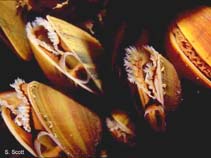
Bivalvia |
Mytilida |
Mytilidae
Miljö: miljö / Klimatzon / djupintervall / distributionsområde
Ekologi
Benthic; brackvatten; djupintervall 0 - 60 m (Ref. 7726). Temperate, preferred 9°C (Ref. 107945); 89°N - 58°S, 112°E - 61°E
Circumpolar.
Längd vid första mognad / Storlek / Vikt / Ålder
Könsmognad: Lm ? range ? - ? cm Max length : 11.0 cm SHL hane/ej könsbestämd; (Ref. 95344); rapporterad maxålder: 24 år (Ref. 8702)
Minimum depth (intertidal zone) from Ref. 95344. Inhabits intertidal areas (Ref. 2789). Found in quiet, sheltered areas forming dense aggregates on hard surfaces; attached by strong byssal threads (Ref. 95344). In the Vainameri, north-eastern Baltic Sea, most abundant in silty substrate (Ref. 95753). It is infaunal on sand and eelgrass beds and epifaunal on eelgrass beds (Ref. 95819). Also found on mixed sediments with gravel (Ref. 118257). Semi-mobile suspension feeder (Refs. 95752, 96470). Feeds on phytoplankton such as green algae, dinoflagellates and diatoms (Ref. 95805).
Livscykel och parningsbeteende
Könsmognad | Reproduktion | Lek | Ägg | Fekunditet | Larver
Members of the class Bivalvia are mostly gonochoric, some are protandric hermaphrodites. Life cycle: Embryos develop into free-swimming trocophore larvae, succeeded by the bivalve veliger, resembling a miniature clam.
Harvey-Clark, C. 1997 Eastern tidepool and reef: north-central Atlantic marinelife guide. Hancock House Publishers, 64pp. (Ref. 7726)
Status på IUCN:s rödlista
(Ref. 130435: Version 2025-2 (Global))
CITES-status (Ref. 108899)
Not Evaluated
Not Evaluated
Hot mot människor
Mänskliga användningsområden
Fiskeri: kommersiell
FAO - Aquaculture Systems: artprofil, production search; fiskeri: artprofil, landings search; Publication: search | FishSource | Havet omkring oss
Verktyg
Ytterligare information
LivscykelReproduktionKönsmognadFekunditetLekÄggUtveckling av äggLarver MänniskorelateradFrimärken, mynt, diverse.
Internet-källor
Uppskattningar baserade på modeller
Resiliens
(Ref. 69278): |
Hög, lägsta populationsfördubblingstid mindre än 15 månader (K=0.05-1.14; tmax=24) |
Rate of population increase
|
Prior r = 0.54, 95% CL = 0.36 - 0.82, Based on 1 data-limited stock assessment. |
Sårbarhet i fisket
(Ref. 71543) |
Moderate vulnerability (42 of 100). |
Sårbarhet för klimatet
(Ref. 125649) |
Moderate to high vulnerability (50 of 100) |
Priskategori
(Ref. 80766): |
Low. |
Nutrients
|
Calcium = 149 [71, 228] mg/100g; Iron = 8.53 [1.95, 15.11] mg/100g; Protein = 9.88 [8.64, 11.12] %; Omega3 = 0.313 [0.202, 0.423] g/100g; Selenium = 61 [50, 72] μg/100g; VitaminA = 0 μg/100g; Zinc = 2.04 [0.56, 3.51] mg/100g (wet weight); based on nutrient studies. |