Bivalvia |
Mytilida |
Mytilidae
Environnement : milieu / zone climatique / profondeur / gamme de distribution
Écologie
Benthic; profondeur 0 - 100 m (Réf. 95344), usually 0 - 30 m (Réf. 104320). Temperate; 62°N - 18°N, 172°E - 109°W
Eastern Pacific: from Aleutian Islands, Alaska, USA to Baja California and Isla Socorro, Mexico. Subtropical to boreal.
Longueur à la première maturité / Taille / Poids / Âge
Maturité: Lm ? range ? - ? cm Max length : 25.5 cm TL mâle / non sexé; (Réf. 95344); common length : 20.0 cm TL mâle / non sexé; (Réf. 312)
Description synthétique
Morphologie
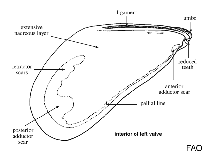
Shell with blue, black and irregular groove lines. Often create dense mats. Mats can form habitats for more than 100 other species (Ref. 312).
It has a shell length of 20 cm long (Ref. 312). Found in dense colonies on wharf piles and surf exposed rocks in the mid to high tide zone. Its diet include fine organic detritus, living plankton, especially dinoflagellates; when the water exceeds a certain temperature, often from late May through October, mussels feed on dinoflagellates that make them poisonous for humans to eat (Ref. 312). Very dominant competitor in an intertidal bed. Prefers to settle on other mussels and barnacles, giving it a competitive advantage (Ref. 104225). Predators are ochre star, dogwinkle, and humans (Ref. 312). Occurs from mid to high tide mark (Ref. 312).
Cycle de vie et comportement reproducteur
Maturité | Reproduction | Frai | Œufs | Fécondité | Larves
Life cycle: Egg develops into the first free-swimming larval stage (trocophore) within 4 to 24 hours, afterwhich it develops into a veliger larvae within 24 to 48 hours. The veliger secretes the first larval shell within 10 to 12 hours, which then develops into a velichoncha larvae which secretes the second larval shell. It further develops into pediveliger, with a characterized foot making it mobile to find a suitable substrate and able to feed. It metamorphoses into a post-larval mussel called plantigrade (Ref. 104799).
Gallivan, G. and J. Danforth 1999 Phylum Mollusca. Marine Science Institute. (Réf. 312)
Statut dans la liste rouge de l'IUCN
(Réf. 130435: Version 2025-2 (Global))
statut CITES (Réf. 108899)
Not Evaluated
Not Evaluated
Menace pour l'homme
Utilisations par l'homme
Pêcheries: commercial
FAO - Publication: search | FishSource | Sea Around Us
Outils
Plus d'informations
Dynamique des populationsCroissance
Âges / tailles maximales
Longueur-poids rel.
Rel. longueur-longueur.
Fréquences de longueurs
Conversion de masse
Abondance
PhysiologieConsommation d'oxygène
Liées à l'hommeTimbres, pièces de monnaie, divers
Sources Internet
Estimations basées sur des modèles
Vulnérabilité de la pêche
(Réf. 71543) |
Low vulnerability (16 of 100). |
Catégorie de prix
(Réf. 80766): |
Low. |