Mytilus californianus, California mussel : fisheries
Advertisement

You can sponsor this page

Mytilus californianus   Conrad, 1837

California mussel

Native range | All suitable habitat | Point map | Year 2050
This map was computer-generated and has not yet been reviewed.
Mytilus californianus  AquaMaps  Data sources: GBIF OBIS
上传你的 图片 
谷歌图片 |
Image of Mytilus californianus (California mussel)
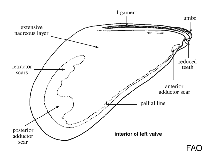
No image available for this species;
drawing shows typical species in Mytilidae.

分类 / 名称 俗名 | 同种异名 | CoL | ITIS | WoRMS

Bivalvia | Mytilida | Mytilidae

环境:氛围 / 气候带 / 深度上下限 / 分布范围 生态学

Benthic; 深度上下限 0 - 100 m (参考文献 95344), usually 0 - 30 m (参考文献 104320).  Temperate; 62°N - 18°N, 172°E - 109°W

分布 Territories | FAO区域 | 生态系 | 标本纪录 | 简介

Eastern Pacific: from Aleutian Islands, Alaska, USA to Baja California and Isla Socorro, Mexico. Subtropical to boreal.

首次成熟时的长度 / 大小 / 重量 / 年龄

成熟度: Lm ?  range ? - ? cm Max length : 25.5 cm TL 雄鱼/尚未辨别雌雄; (参考文献 95344); common length : 20.0 cm TL 雄鱼/尚未辨别雌雄; (参考文献 312)

简单描述 型态特徵

Shell with blue, black and irregular groove lines. Often create dense mats. Mats can form habitats for more than 100 other species (Ref. 312).

生物学特性     字汇 (例如 附生)

It has a shell length of 20 cm long (Ref. 312). Found in dense colonies on wharf piles and surf exposed rocks in the mid to high tide zone. Its diet include fine organic detritus, living plankton, especially dinoflagellates; when the water exceeds a certain temperature, often from late May through October, mussels feed on dinoflagellates that make them poisonous for humans to eat (Ref. 312). Very dominant competitor in an intertidal bed. Prefers to settle on other mussels and barnacles, giving it a competitive advantage (Ref. 104225). Predators are ochre star, dogwinkle, and humans (Ref. 312). Occurs from mid to high tide mark (Ref. 312).

生命周期和交配行为 成熟度 | 繁殖 | 产卵场 | | 孕卵数 | 仔鱼

Life cycle: Egg develops into the first free-swimming larval stage (trocophore) within 4 to 24 hours, afterwhich it develops into a veliger larvae within 24 to 48 hours. The veliger secretes the first larval shell within 10 to 12 hours, which then develops into a velichoncha larvae which secretes the second larval shell. It further develops into pediveliger, with a characterized foot making it mobile to find a suitable substrate and able to feed. It metamorphoses into a post-larval mussel called plantigrade (Ref. 104799).

主要参考文献 参考文献 | 合作者 | 合作者

Gallivan, G. and J. Danforth 1999 Phylum Mollusca. Marine Science Institute. (参考文献 312)

世界自然保护联盟红皮书 (参考文献 130435: Version 2025-2 (Global))

  不评价 

引用情况 (参考文献 108899)

Not Evaluated

CMS (参考文献 116361)

Not Evaluated

对人类的威胁

人类利用

渔业: 商业性
FAO - Publication: search | FishSource | 周边海洋

工具

更多信息

营养生态学
食物(猎物)
食性组成
食物消耗量
捕食者
生态学
人口动态
成长
最大年龄/尺寸
长度-重量关系
长短关系
体长-频率
质量转换
丰度
生命周期
繁殖
成熟度
孕卵数
产卵场

卵的发育
仔鱼
生理学
耗氧量
与人类有关
邮票、硬币、杂项
外联
参考文献

网络资源

BHL | BOLD Systems | CISTI | DiscoverLife | FAO - Publication: search | Fishipedia | GenBank (基因组, 核苷酸) | GloBI | Gomexsi | Google Books | Google Scholar | Google | PubMed | 树状分类阶层 | Wikipedia (转至, 搜寻) | 动物学的记录

基于模型的估算

渔业脆弱性
(参考文献 71543)
Low vulnerability (16 of 100).
价格分类
(参考文献 80766):
Low.