Bivalvia |
Mytilida |
Mytilidae
Milieu: milieu / Klimaatzone / Diepte / verspreidingsgebied
Ecologie
Benthic; diepte 0 - 15 m (Ref. 348). Tropical
Indo-Pacific: from East and South Africa, to Japan, Australia, New Caledonia and eastern Polynesia.
Lengte bij maturiteit / Grootte / Gewicht / Leeftijd
Maturiteit: Lm ? range ? - ? cm Max length : 5.0 cm SHL mannelijk / geslacht onbekend; (Ref. 348); common length : 4.0 cm SHL mannelijk / geslacht onbekend; (Ref. 348)
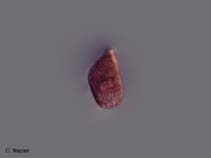
Shell thick, elongate, variable in shape, roughly trigonal-ovate or trapezoidal in outline, markedly swollen and pointed anteriorly, rounded and somewhat compressed posteriorly. Umbones terminal, prominent, sharply tapering and ventrally recurved. Anterior margin reduced. Ventral margin long and usually broadly concave. Posterodorsal area somewhat expanded and laterally compressed. Outer surface of valves covered with numerous, densely set radial riblets slightly diverging on posterodorsal and posteroventral areas. Periostracum strong, tightly applied to shell. Hinge with a few small denticles under the umbo of each valve. A strong shelly ledge above the umbonal cavity, supporting the anterior adductor scar and expanded dorsally as a low ridge along the ligament. Internal margins finely crenulated throughout. Colour: exterior of shell deep green, becoming brownish and paler towards the umbones. Interior bluish grey to purplish brown, white on the umbonal area.
Frequently found in areas exposed to washing of surf with strong water current (Ref. 80041). Attached to rocks, dead corals or the underside of stones, sometimes occurring in dense colonies. Littoral and sublittoral to a depth of about 15 m (Ref. 348). Living among the alga Corallina officinalis in rock-pools between tide-marks (Ref. 88739). Reported from Hong Kong to be found on the ceilings and walls of submarine caves (Ref. 126058).
Levenscyclus en paargedrag
Maturiteit | Voortplanting | Paaien | Eieren | Fecunditeit | Larven
Members of the class Bivalvia are mostly gonochoric, some are protandric hermaphrodites. Life cycle: Embryos develop into free-swimming trocophore larvae, succeeded by the bivalve veliger, resembling a miniature clam.
Poutiers, J.M. 1998 Bivalves. Acephala, Lamellibranchia, Pelecypoda. p. 123-362. In Carpenter, K. E. and V. H. Niem. 1998. FAO species identification guide for fishery purposes. The living marine resources of the Western Central Pacific. Volume 1. Seaweeds, corals, bivalves, and gastropods. Rome, FAO. (Ref. 348)
Status op de Rode Lijst van het IUCN
(Ref. 130435: Version 2025-2 (Global))
CITES status (Ref. 108899)
Not Evaluated
Not Evaluated
Gevaar voor de mens
Gebruik door de mens
FAO - Publication: search | FishSource |
Tools
Meer informatie
Trofische ecologieVoedsel (prooien)
Dieetsamenstelling
Voedselconsumptie
Predatoren
LevenscyclusVoortplantingMaturiteitFecunditeitPaaienEierenOntwikkeling van de eierenLarven FysiologieZuurstofverbruik
Menselijk gerelateerdPostzegels, munten, diversen.
Internetbronnen
Schattingen op basis van modellen
Weerstandsvermogen
(Ref. 69278): |
Gemiddeld, minimale populatieverdubbelingstijd 1,4-4,4 jaar (K=0.23-0.34) |
Kwetsbaarheid van de visserij
(Ref. 71543) |
Low to moderate vulnerability (32 of 100). |
Prijsklasse
(Ref. 80766): |
Medium. |