Bivalvia |
Mytilida |
Mytilidae
Lingkungan: lingkungan / zona iklim / kisaran kedalaman / jangkauan distribusi
Ekologi
Benthic; kisaran kedalaman 0 - 20 m (Acuan 348). Tropical
Indo-West Pacific, Northern Atlantic and the Mediterranean. Introduced to Western North America (Ref. 75831).
Panjang pada saat jatuh tempo pertama / Ukuran / Berat / umur
Kematangan: Lm ? range ? - ? cm Max length : 4.0 cm TL jantan/; (Acuan 95344); common length : 2.5 cm TL jantan/; (Acuan 348)
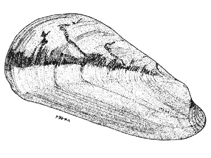
Shell small-sized, thin and fragile, somewhat translucent, roughly trigonal ovate in outline, with a moderately long and rather high in shape. Anterior margin of valves rather short and rounded, clearly extending forwards beyond the umbones. Ventral margin long and straightish. Outer surface of valves smoothish, with numerous concentric growth lines and a few small radial grooves in front of the umbones. Periostracum smooth and shiny, transparent, closely applied to shell surface and sometimes abraded from the umbones. Hinge line with very small crenulations in front of the umbones, along and a short way behind the ligamental margin. Anterior adductor scar present. Internal margins very thin and smooth, undulate anteriorly in relation to the outer radial sculpture. Colour: outside of shell glossy, yellowish green to olive-brown, typically patterned with about 15 narrow, tenuous, reddish brown stripes on posterodorsal slope (one of which is larger and darker), and a number of irregular transverse bands of the same colour. Interior slightly pearly, with the outer colour pattern more or less showing through.
Minimum depth from Ref. 95344. On soft and hard bottoms such as reef platform, intertidally and subtidally to a depth of about 20 m. This opportunistic species is characterized by its fast growth rate and high productive capacity, together with the unique feature to colonize both hard and soft substrates. On hard bottoms, individuals are often nestling among tufts of algae or other colonial mytilids. On soft bottom areas, they can live byssally attached to various objects such as wharf pilings, boat hulls or eelgrass, or weave their byssal threads into an all-enclosing nest, forming large, dense mats with a maximum recorded density of 2 600 specimens per m2. Colonies tending to fluctuate widely and unpredictably in time, even completely disappearing within a few months. They rapidly change sandy bottoms into mud flats through a copious retention of silt and mucous-bound faeces and pseudofaeces, then eliminating other infaunal species of bivalves (Ref. 348).
Siklus hidup dan perilaku kawin
Kematangan | Reproduksi, perkembang biakan | Pemijahan | telur-telur | Fekunditas | Larva
Members of the class Bivalvia are mostly gonochoric, some are protandric hermaphrodites. Life cycle: Embryos develop into free-swimming trocophore larvae, succeeded by the bivalve veliger, resembling a miniature clam.
rujukan utama
Acuan | Koordinator | mitra
Poutiers, J.M. 1998 Bivalves. Acephala, Lamellibranchia, Pelecypoda. p. 123-362. In Carpenter, K. E. and V. H. Niem. 1998. FAO species identification guide for fishery purposes. The living marine resources of the Western Central Pacific. Volume 1. Seaweeds, corals, bivalves, and gastropods. Rome, FAO. (Acuan 348)
Status IUCN Red List
(Acuan 130435: Version 2025-2 (Global))
status CITES (Acuan 108899)
Not Evaluated
Not Evaluated
ancaman kepada manusia
penggunaan manusia
FAO - Publication: search | FishSource |
Alat, peralatan
informasi lanjut
Ekologi trofikItem makanan (mangsa)Komposisi makananKonsumsi makananPemangsa Dinamika populasiPertumbuhanMaks. usia / ukuranPanjang-berat rel.Panjang-panjang rel.ukuran frekuensiKonversi massaKelimpahan FisiologiKonsumsi oksigen
Yang berhubungan dengan manusiaPerangko, koin, dll.
Sumber internet
Estimasi berdasarkan model
Daya lenting
(Ref. 69278): |
Tinggi, Waktu penggandaan populasi minimum kurang dari 15 bulan (K=1.15) |
Kerentanan Penangkapan Ikan
(Acuan 71543) |
Low vulnerability (10 of 100). |
kategori harga
(Acuan 80766): |
Medium. |