Gastropoda |
Ostreida |
Margaritidae
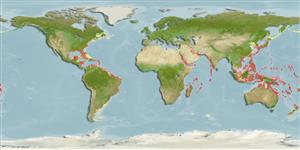
Milieu: milieu / Klimaatzone / Diepte / verspreidingsgebied
Ecologie
Benthic; diepte 0 - 30 m (Ref. 104365). Tropical; 34°N - 37°S, 98°W - 29°W
Western Atlantic: From South Carolina to Uruguay.
Lengte bij maturiteit / Grootte / Gewicht / Leeftijd
Maturiteit: Lm ? range ? - ? cm Max length : 8.8 cm SHL mannelijk / geslacht onbekend; (Ref. 85431); common length : 7.6 cm SHL mannelijk / geslacht onbekend; (Ref. 344); max. gerapporteerde leeftijd: 8 Jaren (Ref. 8702)
Shell roundish, thin, flattened to moderately inflated, inequivalve. Hinge with 2 wing-like projections, posterior projection shorter than that of Pteria colymbus. Periostracum with flat, scale-like projections aligned concentrically. Colour: externally tan, brown, or purplish, with greenish cast, internally nacreous.
Maximum depth from Ref. 85431. Lives attached to rocks or other hard substrates, in shallow subtidal depths. Small live specimens found in rock-pools between tide-marks (Ref. 88739). Common in coralline bottoms (Ref. 128042).
Levenscyclus en paargedrag
Maturiteit | Voortplanting | Paaien | Eieren | Fecunditeit | Larven
Members of the class Bivalvia are mostly gonochoric, some are protandric hermaphrodites. Life cycle: Embryos develop into free-swimming trocophore larvae, succeeded by the bivalve veliger, resembling a miniature clam.
Leal, J.H. 2003 Bivalves. p. 25-98. In Carpenter, K.E. (ed.). The living marine resources of the Western Central Atlantic. Volume 1: Introduction, molluscs, crustaceans, hagfishes, sharks, batoid fishes, and chimaeras. FAO Species Identification Guide for Fishery Purposes and American Society of Ichthyologists and Herpetologists Special Publication No. 5. 1600p. (Ref. 344)
Status op de Rode Lijst van het IUCN
(Ref. 130435: Version 2025-2 (Global))
CITES status (Ref. 108899)
Not Evaluated
Not Evaluated
Gevaar voor de mens
Gebruik door de mens
Visserij: van groot commercieel belang
FAO - Publication: search | FishSource |
Tools
Meer informatie
Trofische ecologieVoedsel (prooien)
Dieetsamenstelling
Voedselconsumptie
Predatoren
FysiologieZuurstofverbruik
Menselijk gerelateerdPostzegels, munten, diversen.
Internetbronnen
Schattingen op basis van modellen
Weerstandsvermogen
(Ref. 69278): |
Hoog, minimale populatieverdubbelingstijd minder dan 15 maanden (K=0.94-1.42; tmax=8) |
Kwetsbaarheid van de visserij
(Ref. 71543) |
Low vulnerability (24 of 100). |
Prijsklasse
(Ref. 80766): |
Unknown. |