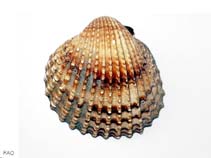
Bivalvia |
Cardiida |
Cardiidae
Environnement : milieu / zone climatique / profondeur / gamme de distribution
Écologie
Benthic; profondeur 0 - 100 m (Réf. 94880). Subtropical; 59°N - 7°S, 26°W - 36°
Northeast Atlantic and the Mediterranean: from Morocco and Portugal, north to UK and North Sea, east to Syria.
Longueur à la première maturité / Taille / Poids / Âge
Maturité: Lm ? range ? - ? cm Max length : 9.0 cm SHL mâle / non sexé; (Réf. 109255); poids max. publié: 3.08 g (Réf. 2734)
Common length from 5.0 to 7.0 cm (Ref. 109255). Found in fine and well sorted sand (Refs. 2723, 2780). An active suspension-feeder (Ref. 96376) and deposit-feeder (Ref. 2743).
Cycle de vie et comportement reproducteur
Maturité | Reproduction | Frai | Œufs | Fécondité | Larves
Members of the class Bivalvia are mostly gonochoric, some are protandric hermaphrodites. Life cycle: Embryos develop into free-swimming trocophore larvae, succeeded by the bivalve veliger, resembling a miniature clam.
Gaspar, M.B., M.N. Santos and P. Vasconcelos 2001 Weight-length relationships of 25 bivalve species (Mollusca: Bivalvia) from the Algarve coast (southern Portugal). J. Mar. Biol. Ass. U.K. 81:805-807. (Réf. 2758)
Statut dans la liste rouge de l'IUCN
(Réf. 130435: Version 2025-2 (Global))
statut CITES (Réf. 108899)
Not Evaluated
Not Evaluated
Menace pour l'homme
Utilisations par l'homme
Pêcheries: commercial
FAO - Publication: search | FishSource | Sea Around Us
Outils
Plus d'informations
Écologie trophiqueAliments (proies)Composition du régime alimentaireConsommation alimentairePrédateurs Dynamique des populations PhysiologieConsommation d'oxygène
Liées à l'hommeTimbres, pièces de monnaie, divers
Sources Internet
Estimations basées sur des modèles
Résilience
(Ref. 69278): |
Haut, temps minimum de doublement de population inférieur à 15 mois (K=0.49-0.77) |
Vulnérabilité de la pêche
(Réf. 71543) |
Low vulnerability (20 of 100). |
Catégorie de prix
(Réf. 80766): |
Low. |
Nutrients
|
Calcium = 149 [71, 228] mg/100g; Iron = 8.53 [1.95, 15.11] mg/100g; Protein = 9.88 [8.64, 11.12] %; Omega3 = 0.313 [0.202, 0.423] g/100g; Selenium = 61 [50, 72] μg/100g; VitaminA = 0 μg/100g; Zinc = 2.04 [0.56, 3.51] mg/100g (wet weight); based on nutrient studies. |