Bivalvia |
Ostreida |
Ostreidae
Milieu: milieu / Klimaatzone / Diepte / verspreidingsgebied
Ecologie
Benthic; brak water; diepte 125 - 200 m (Ref. 2754). Subtropical, preferred 15°C (Ref. 107945)
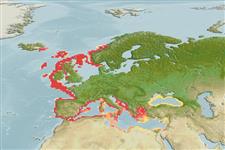
Northeast Pacific, Northeast Atlantic and Mediterranean Sea: UK, Turkey, Greece; introduced in North America.
Lengte bij maturiteit / Grootte / Gewicht / Leeftijd
Maturiteit: Lm ? range ? - ? cm Max length : 12.0 cm SHH mannelijk / geslacht onbekend; (Ref. 88171)
Typically found in rich estuaries and shallow-waters along the tidal zone, attached to stones, compacted mud or silt, muddy sand or gravel substrate, or on bivalve shell fragments. May also be found on wave-exposed areas; and up to depths of 80 m. Prefer salinities between18 to 40; and water temperature of 17°C. Suspension feeders; filters phytoplankton from the ambient waters. Sexual maturity at 3 years. Alternating hermaphrodites; initially producing and releasing sperm as males and then becoming female and producing eggs kept in the mantle cavity where they are fertilized. Highly fecund with 500,000 to more than a million eggs produced by a single individual per year. Incubation in the mantle cavity lasts from 7 to 10 days, followed by a 10 to 30-day planktonic larval veliger stage, until it permanently cements itself with a byssal substance unto the substrate, often in aggregating colonies. Dispersal distances, as influenced by the currents, estimated to be more than 10 km. Life span estimated at 20 to 30 years. A human food source since the Stone Age. German North Sea populations decline began in the late 18th century and attributed to the use of steam ships in oyster fishery; and since the 1950s to 2012, is considered extinct in German waters. Identified hindrance to recolonization include anthropogenic influences such as overfishing and unregulated fishing; presence of invasive species and eutrophication linked to aquaculture; habitat-altering and destructive marine construction activities; poisoning from oil spills and from the liquid biocide, tributyltin hydride, in anti-fouling marine paint used in commercial shipping; as well as temperature and osmotic stress due to climate change (Ref. 88171).
Levenscyclus en paargedrag
Maturiteit | Voortplanting | Paaien | Eieren | Fecunditeit | Larven
Members of the class Bivalvia are mostly gonochoric, some are protandric hermaphrodites. Life cycle: Embryos develop into free-swimming trocophore larvae, succeeded by the bivalve veliger, resembling a miniature clam.
Demir, M. 2003 Shells of mollusca collected from the seas of Turkey. Turkey Journal of Zoology 27:101-140. (Ref. 2754)
Status op de Rode Lijst van het IUCN
(Ref. 130435: Version 2025-2 (Global))
CITES status (Ref. 108899)
Not Evaluated
Not Evaluated
Gevaar voor de mens
Gebruik door de mens
Visserij: commercieel
FAO - Aquaculture Systems: soortsprofiel, production search; visserij: landings search; Publication: search | FishSource | Sea Around Us
Tools
Meer informatie
PopulatiedynamicaGroeiMax. leeftijden / matenLengte-gewicht rel.Lengte-lengte rel.LengtefrequentiesMassaconversieAbundantie LevenscyclusVoortplantingMaturiteitFecunditeitPaaienEierenOntwikkeling van de eierenLarven FysiologieZuurstofverbruik
Menselijk gerelateerdPostzegels, munten, diversen.
Internetbronnen
Schattingen op basis van modellen
Kwetsbaarheid van de visserij
(Ref. 71543) |
Low vulnerability (10 of 100). |
Kwetsbaarheid voor het klimaat
(Ref. 125649) |
High vulnerability (56 of 100) |
Prijsklasse
(Ref. 80766): |
Very high. |
Nutrients
|
Calcium = 149 [71, 228] mg/100g; Iron = 8.53 [1.95, 15.11] mg/100g; Protein = 9.88 [8.64, 11.12] %; Omega3 = 0.313 [0.202, 0.423] g/100g; Selenium = 61 [50, 72] μg/100g; VitaminA = 0 μg/100g; Zinc = 2.04 [0.56, 3.51] mg/100g (wet weight); based on nutrient studies. |