Bivalvia |
Ostreida |
Ostreidae
पर्यावरण: पर्यावरण / जलवायु क्षेत्र / गहराई सीमा / वितरण सीमा
पारिस्थितिकी
Benthic; खारा; गहराई सीमा 125 - 200 m (संदर्भ 2754). Subtropical, preferred 15°C (संदर्भ 107945)
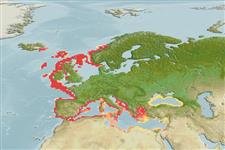
Northeast Pacific, Northeast Atlantic and Mediterranean Sea: UK, Turkey, Greece; introduced in North America.
प्रथम परिपक्वता पर लंबाई / आकार / वज़न / आयु
परिपक्व अवधि: Lm ? range ? - ? cm Max length : 12.0 cm SHH पुल्लिंग / अलिंग; (संदर्भ 88171)
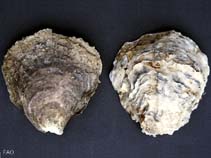
Typically found in rich estuaries and shallow-waters along the tidal zone, attached to stones, compacted mud or silt, muddy sand or gravel substrate, or on bivalve shell fragments. May also be found on wave-exposed areas; and up to depths of 80 m. Prefer salinities between18 to 40; and water temperature of 17°C. Suspension feeders; filters phytoplankton from the ambient waters. Sexual maturity at 3 years. Alternating hermaphrodites; initially producing and releasing sperm as males and then becoming female and producing eggs kept in the mantle cavity where they are fertilized. Highly fecund with 500,000 to more than a million eggs produced by a single individual per year. Incubation in the mantle cavity lasts from 7 to 10 days, followed by a 10 to 30-day planktonic larval veliger stage, until it permanently cements itself with a byssal substance unto the substrate, often in aggregating colonies. Dispersal distances, as influenced by the currents, estimated to be more than 10 km. Life span estimated at 20 to 30 years. A human food source since the Stone Age. German North Sea populations decline began in the late 18th century and attributed to the use of steam ships in oyster fishery; and since the 1950s to 2012, is considered extinct in German waters. Identified hindrance to recolonization include anthropogenic influences such as overfishing and unregulated fishing; presence of invasive species and eutrophication linked to aquaculture; habitat-altering and destructive marine construction activities; poisoning from oil spills and from the liquid biocide, tributyltin hydride, in anti-fouling marine paint used in commercial shipping; as well as temperature and osmotic stress due to climate change (Ref. 88171).
जीवन चक्र और संभोग व्यवहार
परिपक्व अवधि | पुनरुत्पत्ति | मछलीऔ का अंडे देना | अंडे | उपजाऊपन | लार्वा
Members of the class Bivalvia are mostly gonochoric, some are protandric hermaphrodites. Life cycle: Embryos develop into free-swimming trocophore larvae, succeeded by the bivalve veliger, resembling a miniature clam.
Demir, M. 2003 Shells of mollusca collected from the seas of Turkey. Turkey Journal of Zoology 27:101-140. (संदर्भ 2754)
आईयूसीएन रेड लिस्ट स्थिति
(संदर्भ 130435: Version 2025-2 (Global))
CITES स्थिति (संदर्भ 108899)
Not Evaluated
CMS (संदर्भ 116361)
Not Evaluated
मनुष्यों के लिए ख़तरा
मानव उपयोग
मात्स्यिकी: व्यापारिक
FAO - Aquaculture Systems: प्रजातियों की प्रोफ़ाइल, production search; मात्स्यिकी: landings search; Publication: search | FishSource | हमारे चारों ओर समुद्र
साधन
अधिक जानकारी
जनसंख्या गतिशीलताबाढ़अधिकतम आयु/आकारलंबाई-वजन संबंधलंबाई-लंबाई संबंधलंबाई-आवृत्तियाँसामूहिक रूपांतरणबहुतायत जीवन चक्रपुनरुत्पत्तिपरिपक्व अवधिउपजाऊपनमछलीऔ का अंडे देनाअंडेअंडे का विकासलार्वा फिजियोलॉजीप्राणवायु की खपत
मानव संबंधीटिकट, सिक्के, विविध.
इंटरनेट स्रोत
मॉडल पर आधारित अनुमान
मछली पकड़ने की भेद्यता
(संदर्भ 71543) |
Low vulnerability (10 of 100). |
जलवायु भेद्यता
(संदर्भ 125649) |
High vulnerability (56 of 100) |
मूल्य श्रेणी
(संदर्भ 80766): |
Very high. |
Nutrients
|
Calcium = 149 [71, 228] mg/100g; Iron = 8.53 [1.95, 15.11] mg/100g; Protein = 9.88 [8.64, 11.12] %; Omega3 = 0.313 [0.202, 0.423] g/100g; Selenium = 61 [50, 72] μg/100g; VitaminA = 0 μg/100g; Zinc = 2.04 [0.56, 3.51] mg/100g (wet weight); based on nutrient studies. |