Bivalvia |
Venerida |
Veneridae
Milieu: milieu / Klimaatzone / Diepte / verspreidingsgebied
Ecologie
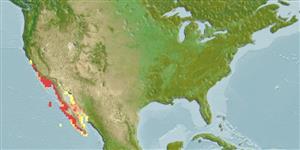
Benthic; diepte 7 - 150 m (Ref. 101604), usually 10 - 25 m (Ref. 101635). Tropical; 38°N - 18°N, 123°W - 109°W
Eastern Pacific: Socorro Island, Mexico to Santa Cruz, California, USA.
Lengte bij maturiteit / Grootte / Gewicht / Leeftijd
Maturiteit: Lm ?, range 2 - 3.1 cm Max length : 15.0 cm SHL mannelijk / geslacht onbekend; (Ref. 101635)
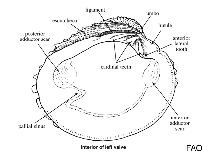
The shell is strong, heavy, and generally smooth though sculptured with fine concentric growth lines; beak nearly central; ligament obvious, elongate, set in deep groove; periostracum shiny, greenish to brownish; shell pale buff to dark chocolate, occasionally marked with brown or purple-brown bands.
Maximum depth from Ref. 101605. Filter-feeder, feeds on phyto- and zooplankton, bacteria and detritus. Its predators may include crabs, snails, gulls, sea otters, sharks, rays and some fishes (Ref. 101635).
Gametogenesis begins in March or April and ripe gametes first appear in April and May. Gonadal development proceeds rapidly in June and July; spawning begins in late July or early August and continues to the end of November. Discharge of gametes appears to take place when there is a fair rise in water temperature. Males usually spawn first and their release of gametes stimulates the females to spawn. Spawning may occur several times during the season since only a portion of the gametes ripen at one time. (Ref. 101635).
Vakily, J.M. 1992 Determination and comparison of bivalve growth, with emphasis on Thailand and other tropical areas. ICLARM Technical Report 36:1-125. (Ref. 7693)
Status op de Rode Lijst van het IUCN
(Ref. 130435: Version 2025-2 (Global))
CITES status (Ref. 108899)
Not Evaluated
Not Evaluated
Gevaar voor de mens
Gebruik door de mens
Visserij: commercieel
FAO - Publication: search | FishSource |
Tools
Meer informatie
FysiologieZuurstofverbruik
Menselijk gerelateerdPostzegels, munten, diversen.
Internetbronnen
Schattingen op basis van modellen
Weerstandsvermogen
(Ref. 69278): |
laag, minimale populatieverdubbelingstijd 4,5-14 jaar (K=0.12-0.18) |
Kwetsbaarheid van de visserij
(Ref. 71543) |
Moderate to high vulnerability (54 of 100). |
Prijsklasse
(Ref. 80766): |
Medium. |