Bivalvia |
Venerida |
Veneridae
Umwelt: Milieu / Klimazone / Tiefenbereich / Verbreitungsgebiet
Ökologie
Benthic; tiefenbereich 0 - 2 m (Ref. 83435). Tropical, preferred 27°C (Ref. 107945); 22°N - 29°S, 89°W - 14°W
Western Atlantic: from Guatemala to Cuba in the Caribbean, east to Ascension Island and south to Santa Catarina Brazil.
Länge bei der ersten Reifung / Größe / Gewicht / Alter
Geschlechtsreife: Lm ? range ? - ? cm Max length : 3.4 cm DL Männchen/unbestimmt; (Ref. 83435); common length : 3.8 cm TL Männchen/unbestimmt; (Ref. 344)
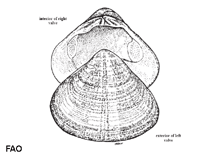
Shell heavy, thick, inflated, triangular. Shell surface umbones central and prominent. Hinge with 3 cardinal teeth, with smaller secondary teeth present. Lateral tooth in left valve large. Lunula large, escutcheon absent. Periostracum like varnish. Colour: whitish with brown tinges and rays.
Minimum depth from Ref. 104365. Lives in sand, from the intertidal to very shallow subtidal (Refs. 344, 114796). Shallowly buried in sandy bottoms (Ref. 114795). Abundant near river mouths where organic matter and terrigenous particulates accumulate (Ref. 114796). Suspension feeder (Ref. 78149).
Lebenszyklus und Paarungsverhalten
Geschlechtsreife | Fortpflanzung | Ablaichen | Eier | Fruchtbarkeit | Larven
Members of the class Bivalvia are mostly gonochoric, some are protandric hermaphrodites. Life cycle: Embryos develop into free-swimming trocophore larvae, succeeded by the bivalve veliger, resembling a miniature clam.
Leal, J.H. 2003 Bivalves. p. 25-98. In Carpenter, K.E. (ed.). The living marine resources of the Western Central Atlantic. Volume 1: Introduction, molluscs, crustaceans, hagfishes, sharks, batoid fishes, and chimaeras. FAO Species Identification Guide for Fishery Purposes and American Society of Ichthyologists and Herpetologists Special Publication No. 5. 1600p. (Ref. 344)
IUCN Rote Liste Status
(Ref. 130435: Version 2025-2 (Global))
CITES Status (Ref. 108899)
Not Evaluated
Not Evaluated
Bedrohung für Menschen
Nutzung durch Menschen
Fischereien: kommerziell
FAO - Fischereien: landings search; Publication: search | FishSource | Das Meer um uns herum
Tools
Mehr Information
Trophische ÖkologieLebensmittel (Beutetiere)
Nahrungszusammensetzung
Nahrungsaufnahme
Räuber
PopulationsdynamikWachstumMax. Alter/GrößenLänge-Gewicht-Rel.Länge-Länge-Verhältnis.LängenhäufigkeitenMassenkonvertierungDichte LebenszyklusFortpflanzungGeschlechtsreifeFruchtbarkeitAblaichenEierEientwicklungLarven PhysiologieSauerstoffverbrauch
MenschenbezogenBriefmarken, Münzen, Verschiedenes.
Internet Quellen
Schätzungen auf der Grundlage von Modellen
Rate of population increase
|
Prior r = 1.18, 95% CL = 0.78 - 1.77, Based on 1 data-limited stock assessment. |
Anfälligkeit der Fischerei
(Ref. 71543) |
Low vulnerability (10 of 100). |
Klimaanfälligkeit
(Ref. 125649) |
High to very high vulnerability (71 of 100) |
Preiskategorie
(Ref. 80766): |
Very high. |
Nutrients
|
Calcium = 149 [71, 228] mg/100g; Iron = 8.53 [1.95, 15.11] mg/100g; Protein = 9.88 [8.64, 11.12] %; Omega3 = 0.313 [0.202, 0.423] g/100g; Selenium = 61 [50, 72] μg/100g; VitaminA = 0 μg/100g; Zinc = 2.04 [0.56, 3.51] mg/100g (wet weight); based on nutrient studies. |