Bivalvia |
Venerida |
Veneridae
Môi trường: môi trường / vùng khí hậu / Mức độ sâu / phạm vi phân phối
Sinh thái học
Benthic; mức độ sâu 0 - 2 m (Tài liệu tham khảo 83435). Tropical, preferred 27°C (Tài liệu tham khảo 107945); 22°N - 29°S, 89°W - 14°W
Western Atlantic: from Guatemala to Cuba in the Caribbean, east to Ascension Island and south to Santa Catarina Brazil.
Chiều dài lúc trưởng thành đầu tiên / Bộ gần gũi / Khối lượng (Trọng lượng) / Tuổi
Chín muồi sinh dục: Lm ? range ? - ? cm Max length : 3.4 cm DL con đực/không giới tính; (Tài liệu tham khảo 83435); common length : 3.8 cm TL con đực/không giới tính; (Tài liệu tham khảo 344)
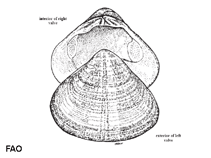
Shell heavy, thick, inflated, triangular. Shell surface umbones central and prominent. Hinge with 3 cardinal teeth, with smaller secondary teeth present. Lateral tooth in left valve large. Lunula large, escutcheon absent. Periostracum like varnish. Colour: whitish with brown tinges and rays.
Minimum depth from Ref. 104365. Lives in sand, from the intertidal to very shallow subtidal (Refs. 344, 114796). Shallowly buried in sandy bottoms (Ref. 114795). Abundant near river mouths where organic matter and terrigenous particulates accumulate (Ref. 114796). Suspension feeder (Ref. 78149).
Vòng đời và hành vi giao phối
Chín muồi sinh dục | Sự tái sinh sản | Đẻ trứng | Các trứng | Sự sinh sản | Ấu trùng
Members of the class Bivalvia are mostly gonochoric, some are protandric hermaphrodites. Life cycle: Embryos develop into free-swimming trocophore larvae, succeeded by the bivalve veliger, resembling a miniature clam.
Leal, J.H. 2003 Bivalves. p. 25-98. In Carpenter, K.E. (ed.). The living marine resources of the Western Central Atlantic. Volume 1: Introduction, molluscs, crustaceans, hagfishes, sharks, batoid fishes, and chimaeras. FAO Species Identification Guide for Fishery Purposes and American Society of Ichthyologists and Herpetologists Special Publication No. 5. 1600p. (Tài liệu tham khảo 344)
Tình trạng Sách đỏ IUCN
(Tài liệu tham khảo 130435: Version 2025-2 (Global))
tình trạng CITES (Tài liệu tham khảo 108899)
Not Evaluated
CMS (Tài liệu tham khảo 116361)
Not Evaluated
Mối đe dọa đối với con người
Sử dụng của con người
Các nghề cá: tính thương mại
FAO - Các nghề cá: landings search; Publication: search | FishSource | Biển chung quanh ta
Các công cụ
Thêm thông tin
Sinh thái dinh dưỡngThức ăn (con mồi)
Thành phần thức ăn
Thành phần thức ăn
Các động vật ăn mồi
Vòng đờiSự tái sinh sảnChín muồi sinh dụcSự sinh sảnĐẻ trứngCác trứngSự phát triển của trứngẤu trùng Sinh lý họcThành phần ô-xy
Liên quan đến con ngườiTem, tiền xu, v.v.
Các nguồn internet
Ước tính dựa trên mô hình
Rate of population increase
|
Prior r = 1.18, 95% CL = 0.78 - 1.77, Based on 1 data-limited stock assessment. |
Sự dễ bị tổn thương của nghề đánh cá
(Tài liệu tham khảo 71543) |
Low vulnerability (10 of 100). |
Sự dễ bị tổn thương của khí hậu
(Tài liệu tham khảo 125649) |
High to very high vulnerability (71 of 100) |
Loại giá
(Tài liệu tham khảo 80766): |
Very high. |
Nutrients
|
Calcium = 149 [71, 228] mg/100g; Iron = 8.53 [1.95, 15.11] mg/100g; Protein = 9.88 [8.64, 11.12] %; Omega3 = 0.313 [0.202, 0.423] g/100g; Selenium = 61 [50, 72] μg/100g; VitaminA = 0 μg/100g; Zinc = 2.04 [0.56, 3.51] mg/100g (wet weight); based on nutrient studies. |