Gastropoda |
Neogastropoda |
Fasciolariidae
Umwelt: Milieu / Klimazone / Tiefenbereich / Verbreitungsgebiet
Ökologie
Benthic. Tropical
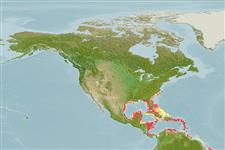
Western Central Atlantic.
Länge bei der ersten Reifung / Größe / Gewicht / Alter
Geschlechtsreife: Lm ? range ? - ? cmCommon length : 60.0 cm TL Männchen/unbestimmt; (Ref. 355)
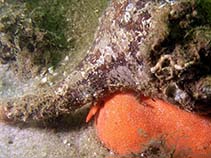
Shell large, with up to 10 whorls. Sculpture of about 5 to 7 spiral cords and weak axial ribs that sometimes form knobs on whorl shoulders. Columella with 3 plications. Periostracum sometimes flaky. Colour: shell greyish white to salmon orange, usually orange in younger specimens; periostracum dark brown to light tan.
This the largest gastropod in American waters, and the Florida State Shell. A variety lacking nodules known as 'knob less wonder' can be found in southwestern Florida. Broad, muscular foot is locally consumed in northwestern Mexico (Ref. 355). Intertidal to shallow subtidal, on sand and mud flats and seagrass beds (Ref. 355).
Lebenszyklus und Paarungsverhalten
Geschlechtsreife | Fortpflanzung | Ablaichen | Eier | Fruchtbarkeit | Larven
This species is a non-broadcast spawner. Life cycle does not include trocophore stage. Also Ref. 833.
Leal, J.H. 2003 Gastropods. p. 99-147. In Carpenter, K.E. (ed.). The living marine resources of the Western Central Atlantic. Volume 1: Introduction, molluscs, crustaceans, hagfishes, sharks, batoid fishes, and chimaeras. FAO Species Identification Guide for Fishery Purposes and American Society of Ichthyologists and Herpetologists Special Publication No. 5. 1600p. (Ref. 355)
IUCN Rote Liste Status
(Ref. 130435: Version 2025-2 (Global))
CITES Status (Ref. 108899)
Not Evaluated
Not Evaluated
Bedrohung für Menschen
Nutzung durch Menschen
Fischereien: kommerziell
FAO - Publication: search | FishSource |
Tools
Mehr Information
Trophische ÖkologieLebensmittel (Beutetiere)
Nahrungszusammensetzung
Nahrungsaufnahme
Räuber
PopulationsdynamikWachstum
Max. Alter/Größen
Länge-Gewicht-Rel.
Länge-Länge-Verhältnis.
Längenhäufigkeiten
Massenkonvertierung
Dichte
LebenszyklusFortpflanzungGeschlechtsreifeFruchtbarkeitAblaichenEierEientwicklungLarven PhysiologieSauerstoffverbrauch
MenschenbezogenBriefmarken, Münzen, Verschiedenes.
Internet Quellen
Schätzungen auf der Grundlage von Modellen
Anfälligkeit der Fischerei
(Ref. 71543) |
(0 of 100). |
Preiskategorie
(Ref. 80766): |
Unknown. |