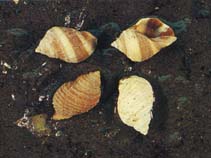
Gastropoda |
Neogastropoda |
Muricidae
Lingkungan: lingkungan / zona iklim / kisaran kedalaman / jangkauan distribusi
Ekologi
Benthic; kisaran kedalaman 0 - 40 m (Acuan 88171). Temperate; 77°N - 35°N, 74°W - 32°E
Northern Atlantic and the Arctic. Temperate to polar.
Panjang pada saat jatuh tempo pertama / Ukuran / Berat / umur
Kematangan: Lm ? range ? - ? cm Max length : 4.0 cm DL jantan/; (Acuan 83435); Umur maksimum dilaporkan: 6 Tahun (Acuan 8702)
Grows to a length (apex to basal edge) of about 4.2 cm (Ref. 88171). Usually found on wave-exposed to sheltered rocky coasts and tidal flats, mainly along the littoral zone and rarely in the sublittoral to 40 m depth. This species avoids areas of low salinity and with dense algal growth, as well as sandy or muddy areas. Instead, both adults and juveniles prefer to inhabit rocky substrates in shaded to open areas. Juveniles develop below the mean water stand and as they mature, move upward along the littoral zone. Known to seek shelter in rock crevices or under algal growth during adverse weather. Feeds on tube-dwelling polychaetes, barnacles, other snails, and certain bivalves, particularly blue mussels. It uses its radula, along with an accessory organ that secretes dissolving enzymes, to bore through the shells of its prey; taking about 7 hours to drill through a 0.1 mm-thick shell. It then injects an anesthetic toxin, pumps in digestive enzymes into its victim, and feeds by sucking on the pre-digested fluid. As active predators, it is known to travel a few to several centimeters in a day. Dioecious and reaches sexual maturity at about 3 years. Forms aggregations of about 30 or more individuals during the breeding period as well as in winter. Reproduction characterized by repeated cycles of internal fertilization and egg-laying; these encapsulated eggs are 1 cm long and is attached to rocks. This primary reproductive period may last for 6 months, and up to a year for some individuals. The number of eggs per season varies between 20 to over a hundred, depending on the individual and on optimal environmental conditions. In temperate areas, egg development takes about 4 months, after which, around 20 juvenile snails, resembling adults except in size, emerge from each egg capsule. Life span estimated at 5 to 6 years. Limited genetic exchange between populations, primarily due to its limited migratory habit and the absence of a planktonic larval stage that further limits its dispersion, categorizes this species as sensitive to disturbances. Identified population threats include anthropogenic factors such as exposure to toxic substances (e.g., the liquid biocide, tributyltin hydride in anti-fouling marine paint used in the shipping and boating industry; and oil pollution), intentional habitat removal (primarily as shell collectors’ objects), and eutrophication; as well as the effects of climate change such as shell dissolution, temperature stress, osmotic stress and unusually rough weather conditions (Ref. 88171).
This species is a non-broadcast spawner. Life cycle does not include trocophore stage. Also Ref. 833.
rujukan utama
Acuan | Koordinator | mitra
Harms, J. 1993 Check list of species (algae, invertebrates and vertebrates) found in the vicinity of the island of Helgoland (North Sea, German Bight) - a review of recent records. Helgoländer Meeresunters 47:1-34. (Acuan 2711)
Status IUCN Red List
(Acuan 130435: Version 2025-2 (Global))
status CITES (Acuan 108899)
Not Evaluated
Not Evaluated
ancaman kepada manusia
penggunaan manusia
Perikanan: komersial
FAO - Publication: search | FishSource |
Alat, peralatan
informasi lanjut
FisiologiKonsumsi oksigen
Yang berhubungan dengan manusiaPerangko, koin, dll.
Sumber internet
Estimasi berdasarkan model
Kerentanan Penangkapan Ikan
(Acuan 71543) |
Low to moderate vulnerability (26 of 100). |
kategori harga
(Acuan 80766): |
Unknown. |